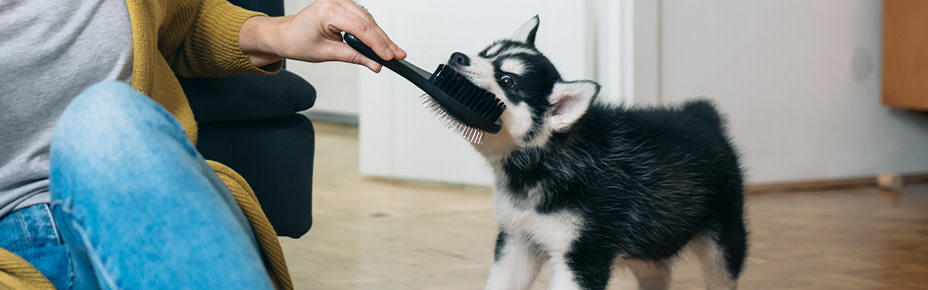
Yay, your puppy is moving in!
When your puppy sets their little paws in their new home for the first time, it’s a very special moment. From now on, you’re about to share a life full of play, fun, and cuddles together. But with this exciting new beginning, you probably have a few questions running through your mind. What do I need to keep in mind on the first day with my puppy? What about vaccinations and how do they work? We’ll give you an overview of all the questions you might have when starting out with your puppy.
The first days in the new home
The move
Moving day is a very exciting event—especially for your little furball: in just one day, they leave their mom and siblings behind and encounter many everyday things for the first time.
Before you pick up your little darling, you should make a few preparations in your apartment or house. Make sure to place any toxic houseplants out of puppy’s reach. This goes for anything you don’t want your puppy’s sharp teeth to destroy or that could be potentially dangerous. That includes cables and electrical devices.
If you live on more than one floor, it’s a good idea to install a gate at the stairs for safety. Puppies are very unsure on stairs at first. You should also make your balcony fall-proof or keep it inaccessible.
For optimal care of your puppy, the right →puppy nutrition and accessories are essential. Discover our range of food and practical accessories, perfectly tailored to the needs of puppies.
Pick-up day
On the way to their new home, your puppy may urinate or defecate, or even vomit. That’s why you should cover the back seat of your car with absorbent pads like a few towels and a cozy blanket. It’s completely normal if your puppy gets diarrhea or vomits during the ride—it’s a sign of nervousness and dizziness in the car —after all, it’s probably their first time. So make sure to take enough breaks during the journey.
Be sure to talk to the breeder or the shelter staff again. The current feeding schedule and food are important—get detailed information about this. When it comes to vaccinations, make sure you get your puppy’s vaccination card to take with you.
Once you arrive home, your little four-legged friend will need to relieve themselves. Find a patch of grass near your home where your puppy can sniff around, pee, and do their business undisturbed. Then they’re ready for their new home. For the rest of the day, it’s important that your puppy gets plenty of rest . Let them explore everything on their own—of course, you can cuddle them if they come to you.
The first night in the new home
For the first night in the new home, remember: your puppy needs to feel close to you. A large, lockable crate should be placed as close to your bed as possible. In the first few nights, it can also help to sleep on the floor next to your furball. We advise against letting your puppy sleep in your bed, even if you plan to allow it later on.
In bed, your puppy might not be able to let you know when they need to go out and may end up relieving themselves there. Next to your bed, in their crate your puppy will make themselves heard loudly so you wake up and can react right away, which is why we recommend using a crate. You can line it with a cozy blanket to make your little furball comfortable.
Give this a try!
Vaccinations, deworming & more
The thing about vaccinations
Most new dog parents find out from the breeder or shelter whether a puppy has been vaccinated, and in most cases, puppies have already had their first vaccination on adoption day. But what exactly does this first vaccination cover? And will your puppy need another one soon? Among vaccinations, there are so-called mandatory and optional vaccinations. The mandatory vaccinations, which your puppy may have already received before moving, include protection against diseases such as
Hepatitis (inflammation of the liver),
distemper,
parvovirus,
rabies (dangerous viral diseases), and
leptospirosis (bacterial infectious disease).
At 8 weeks old your puppy is usually vaccinated for the first time. To achieve a basic immunization, further vaccinations are needed, usually at 12 and 16 weeks of age. A suitable vaccination schedule for your furball can be discussed with your veterinarian.
Deworming in puppyhood
While your puppy is still with their mom, they are dewormed every two weeks. Through mother’s milk, worms can be transmitted to the puppies, but this no longer happens once they switch to solid food. Once your little darling is living with you, you don’t need to deworm every two weeks anymore—a three-month interval is completely sufficient.
You might also wonder if these deworming medications, which can kill living organisms, pose a health risk for your puppy. We can reassure you: from a veterinary perspective, these chemical agents pose no danger to your puppy, as the deworming treatments specifically target the body structure of worms, leaving your little four-legged friend unharmed.
If you want to reduce the use of chemical dewormers, you can also go straight to the vet and have the stool tested for worms there.
The microchip
Even if your puppy is more of a couch potato than an adventurer, you’ll take them out into nature, onto the streets, and everywhere else where they might run off. A tag on the collar with your number can help.
In addition to the now outdated tattoo with a code, almost exclusively the microchip—or simply chip—is used today. The rice-grain-sized chip is injected by the vet into the scruff of the neck. From there, it only migrates a few centimeters until it fuses with the shoulder muscle .
Important: After your puppy has been chipped, you must register them online with their personal chip number and your contact details. Otherwise, your furball can’t be identified as yours.
If your little furball runs away, the chip can be scanned with a reader and the associated code can be retrieved. This code is fifteen digits long and contains, in addition to the country code, the manufacturer’s number of the chip producer and the personal identification of your dog. With this information, it can be determined that your little treasure belongs to you.