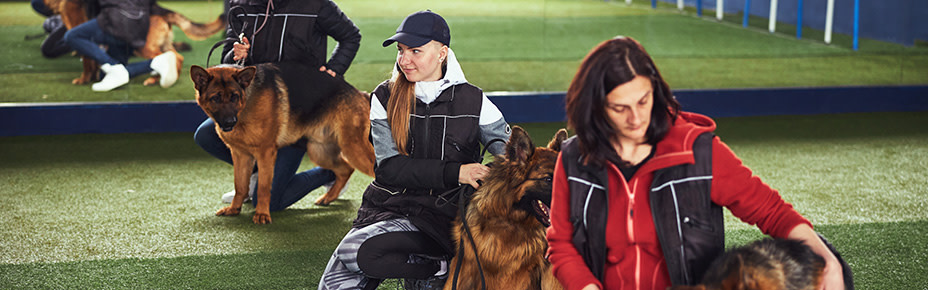
Next stop: Dream job dog trainer
You have already spent a lot of time with dogs and even have your own furry friend at home? Your friends and family constantly ask you for advice and help, and you just can't stop sticking your nose into training books? Very good! Then it's time to pursue a professional training as a dog trainer.
Do you need training?
In principle, the profession of dog trainer is not legally protected. All you need is a permit requirement according to →§ 11 Animal Welfare Act, and then you can get started. Is that advisable? Not really.
It's better to do a proper training. You can complete a course at the Chamber of Industry and Commerce (IHK), take an exam at the Veterinary Chamber, or work with another trainer. Since 2007, there has been a nationwide certification through the Veterinary Chamber. Many dog schools also offer their own training and trainer certificates for anyone who wants to become a dog trainer.
Online, part-time, or full-time
You don't always have to complete the trainer's license full-time. You can also finish the training to become a dog trainer online or part-time. In an online training for dog trainers, the practical part is often made up in specific modules or must be submitted as internships. The practical hours of a part-time dog trainer training often take place on weekends.
Expert for everyday life or specialist?
When choosing your training institution, you should already consider in which area you want to work later. Dog sports, therapy, everyday companions, or perhaps even training so-called "problem dogs"? If you already know this precisely, it makes sense to adapt your training institution directly to your focus.

Trainer's license or certificate - which is better?
Whether trainer's license or certificate doesn't matter - not quite.
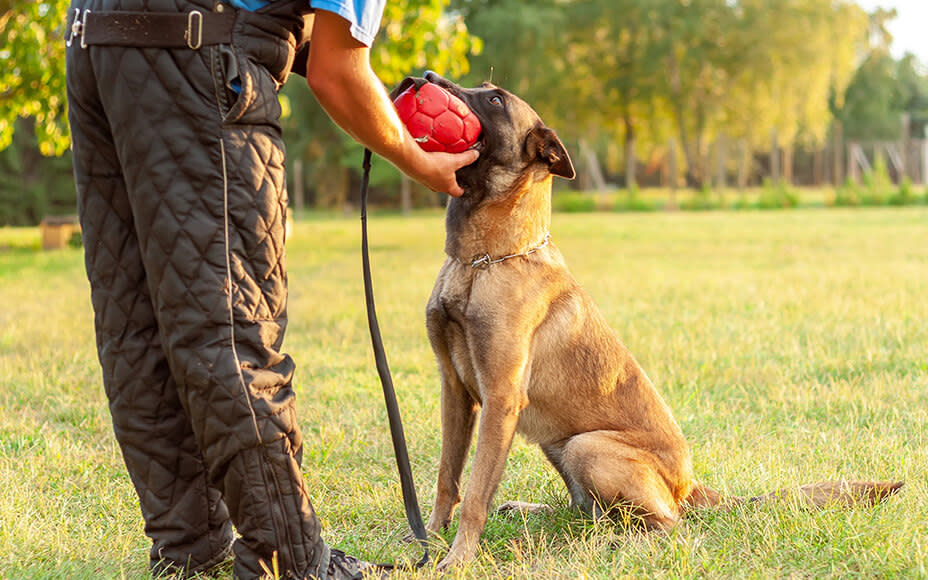
Trainer's license: Here, you are usually specialized in one area. Trainer's licenses are often awarded in dog sports. They make sense if you want to work in a club, for example.
Certified dog trainer: If your wish is to work as a self-employed dog trainer or as an employee in a dog school, a certificate from the Veterinary Chamber or a reputable dog school is advisable. This training path is usually a bit more elaborate and also more expensive. In the end, you have more opportunities for employment.
A combination of theory and practice is crucial
However, training alone is not everything. The two experts Paulina and Luigi from Vitomalia agree that the job of a dog trainer consists of a good combination of professional knowledge, background, and plenty of practical experience. They say: “Just like us humans, dogs do not function according to textbooks, therefore the combination of theory and practice is crucial.”
Important prerequisites: More than just love for dogs
In many training programs, it is required that you bring your own four-legged friend for dog training. It is also helpful if you have previously attended seminars or lectures, read books, or observed other trainers. Practical experiences with many different dogs are invaluable.
Don't forget the right mindset: As a dog trainer, you can always play and cuddle with cute dogs? Not at all! Actually, you work more with people than with dogs. This is an important aspect that should not be overlooked.
Critical curiosity, empathy & accepting boundaries
According to Paulina and Luigi, you should also bring a "certain degree of questioning." What does that mean?
“To question means to *look closely, analyze, and respond accordingly. Those who do not question do not engage intensively with a topic. The topic of dog training is a large area with many different methods and possibilities. Each dog trainer must be able to pick the best for themselves. This, in turn, requires diligence and commitment to critically engage with different topics** to be able to justify why one chooses a certain approach.*”
However, it is also important to continuously question yourself and possibly adjust a methodology that has been applied for years. Regular further education and different experiences that one gathers help with this.
“A good measure of *empathy and a useful gut feeling create a rounded overall picture alongside the professional knowledge. This helps to respond more individually to human-dog teams** and adapt methods to them.”*, say the two dog behavior therapists.
It is also important to know your limits. Not every dog trainer has to be an expert in all topics, according to Lui and Paulina. “There are topics that are better handled by another specialist. Being able to acknowledge your personal limits is a *great strength in the profession of dog training**.”*
How much does a dog trainer earn?
A great job is nice and all, but you still have to earn a living. How much exactly a trainer earns in full-time depends on many individual factors. A salary of about €1,000 to €1,500 per month is definitely guaranteed. If you live in a big city, have your own dog school, are particularly experienced, or specialize in, for example, aggressive dogs, you can naturally charge higher prices.
The good news: Especially during the pandemic, many people have gotten a furry friend. Thus, some dog schools are bursting at the seams. With increasing demand, there is naturally also more room for salary increases.
How much does training to become a dog trainer cost?
But before you earn anything, you first have to invest. The training to become a dog trainer is usually neither free nor a bargain. On average, you can expect to pay around €4,000 to €7,000. At the IHK Potsdam, the course for "Dog Educator and Behavior Consultant (IHK)" costs a total of €6,400. For comparison: At the German Assistance Dog Center T.A.R.S.Q., the training for "Assistance Dog Trainer - Basic" costs €4,399.
3 tips for all future dog trainers
To prepare you well for your new chapter in life, we asked Paulina and Luigi for their top three tips for training.
1. Look at several training institutions!
Although in Germany only a permit requirement is necessary, both agree that a training program is very helpful for initial work experience. Think in advance about the different methods and directions of the training institutions.
“Each training institution has different advantages. We personally do not recommend any training institution by name, as the *own engagement with the methods, contents, and goals** of the training institution gives interested parties a good impression of what to expect.”*
2. Complete different internships!
An internship is a good opportunity to exchange ideas with dog people and learn new things. “Not everything is always relevant for your everyday life as a dog trainer, but the experience and exchange can *broaden your horizons**.”*, say the two trainers.
In practical experience, it is also about continuously questioning your own knowledge: “The more dogs you get to know, who for example are not motivated by food or completely *push you out of your comfort zone, the better prepared you will be for everyday life as a dog trainer and you will learn new ways and possibilities**.”*
3. Those who want to be dog trainers must like people.
Contrary to the expectations of some, the profession primarily means working closely with people. “As a dog trainer, you are the person who guides the *human**. The dog owners are the ones who are supposed to cooperate with their own dog.”*
It is also important to understand the human-dog team, to motivate, to stay engaged, and if necessary, to speak an uncomfortable truth. “Building a close collaboration with the human is sometimes more important than any kind of collaboration between trainer and dog. Because only when the human is ready to create a change can the dog show change.”, say Paulina and Luigi.