What is separation anxiety in dogs?
As the name already suggests, separation anxiety is the fear of being separated from their caregivers. This refers to physical separation, usually when the dog has to stay alone.
Causes: What leads to separation anxiety in dogs?
The reasons for separation anxiety in dogs are very different. Three possible causes can be:
Your dog naturally has a hard time being left alone
Some dogs are "naturally" fine with being alone. Others, however, show from the moment they arrive, usually starting as puppies, that they have difficulty with physical separation from their caregivers. Smaller "separations" like the dog staying in the living room while you fetch something from the kitchen are often not possible.
Typically, these dogs already show in everyday situations that they have difficulty with physical separation from their caregivers. Many owners don't even notice these small signs and only realize the seriousness of the problem when it comes time to actually leave the dog alone at home.
Your dog never learned to be apart from you
Another possible cause is that your dog simply never learned that he sometimes has to be alone. When the puppy moves in with us, we love to be with them around the clock. That's cute and adorable, but it can later lead to some difficulties with being left alone—especially if your dog already shows trouble with physical separation within the home.
That's why practicing being alone as early as possible is important. If the whole process turns out to be more difficult than expected, contact experienced trainers early and work on it together.

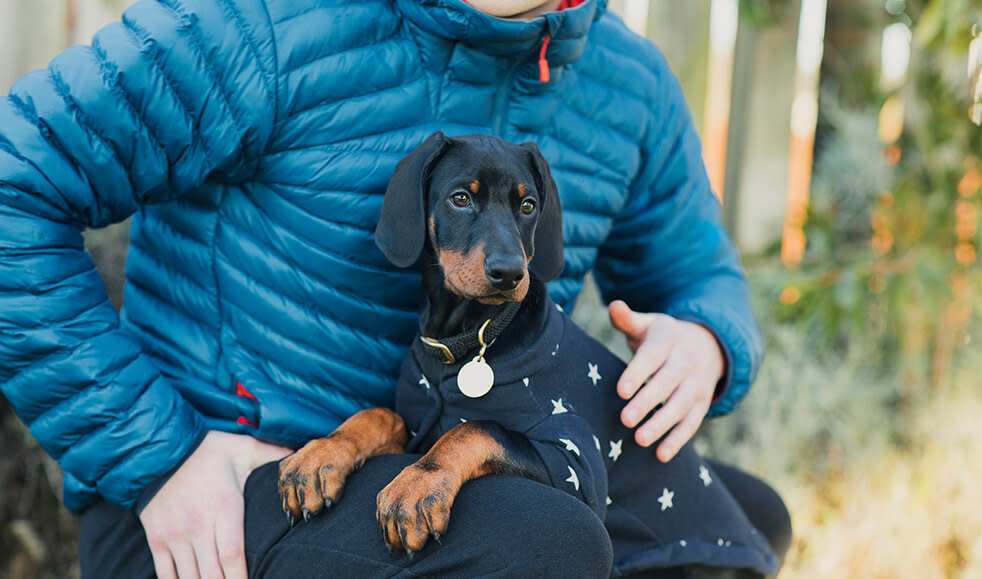
A puppy that accompanies you everywhere is wonderful. But you should also practice leaving them alone early on, so it doesn't become a problem later.
Your dog has had negative formative experiences
Especially second-hand dogs have often experienced a lot and have been shaped by their previous owners influenced. Dogs from animal shelters have also had a wide range of experiences. So every second-hand dog comes to your home with their own baggage; some of them have major fears of loss or trust issues and, once attached to their new caregiver, find it hard to be left alone. Here too, it's important to seek help from experienced professionals and get to the bottom of the issue.
Signs of separation anxiety in dogs
Separation anxiety in dogs is usually quite obvious. However, keep in mind that there can be other causes for these behaviors and the problem with being left alone might be something else. Loss of control, for example, shows itself through very similar behavioral issues. That's why it's even more important to look at the problem in context and work together with experienced trainers to address it.
The following signs may indicate separation anxiety.
Loud barking, whining, whimpering
jumping up at the door, scratching
peeing in the house, pooping indoors
destroying objects
heavy panting and drooling
running wildly through the house, restlessness
excessive licking and chewing on paws

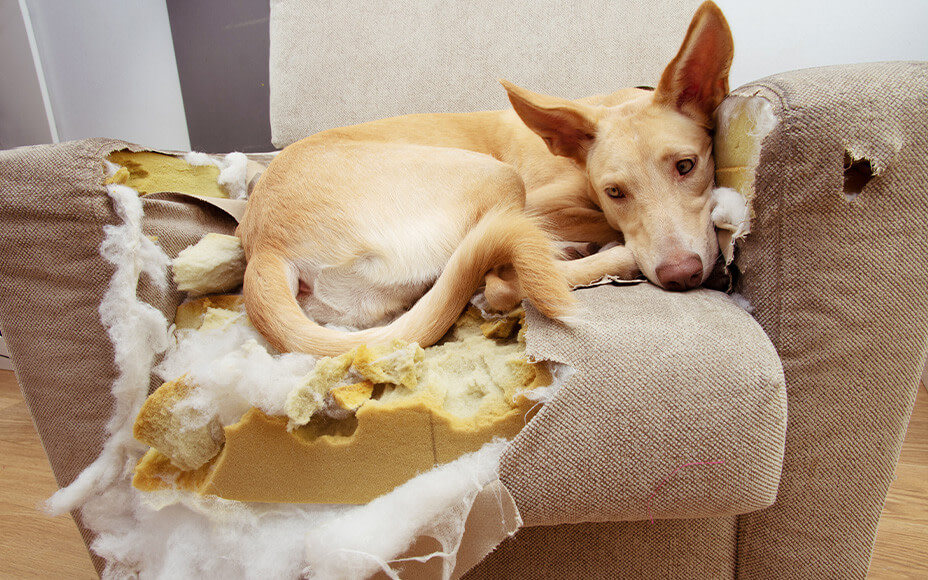
Destroyed furniture, scratched walls, and a completely stressed dog? If your furry friend goes wild when left alone, separation anxiety might be the cause.
Support: Helping your dog overcome anxiety
With such a deep and complex topic as separation anxiety, usually only a step-by-step, patient, and dog-human team-tailored training helps. Separation anxiety has to do with trust and security and is not something that can be fixed with a puzzle toy or a chew snack.
It's important to understand that your four-legged friend doesn't bark, destroy things, or pee on the carpet out of spite. On the contrary: A dog with separation anxiety is extremely stressed, frustrated, and afraid when left alone. The goal of training should be to reduce the stress associated with being alone and for your dog to learn to be relaxed even without you.
Important: Before you start training, have your dog checked by a veterinarian. Illnesses, pain, or hormonal imbalances can also cause stress in your dog.
Whether it's after a successful vet visit or when your dog has managed to stay home alone—the right reward should never be missing. Our delicious snacks have everything a dog's heart desires.
Delicious Rewards for Brave Dogs
Different training approaches for separation anxiety
Since every dog-human team is different and, as mentioned above, the causes of separation anxiety can vary greatly, you need to find a training approach that works well for you. Ideally, talk to several trainers about it and get an idea of which training methods they use.
Possible training approaches could be:
Gradual acclimatization to being alone
In most cases, desensitization is recommended as a therapy method for separation anxiety. In this method, the dog is repeatedly exposed to the anxiety-triggering situation in very small doses. The exercise is always ended on a positive note, meaning before your dog shows any signs of anxiety. For a dog with separation anxiety, this can mean you only leave the room for a few seconds and then return.
It's obvious that this method is a labor-intensive process. Often, owners have to leave the room several times a day for a few seconds to minutes, come back, leave again, come back... This exercise is repeated until the dog remains completely relaxed. Only then is the time spent alone extended by a few seconds.
Minute by minute to relaxed alone time – training your pet to stay alone can definitely become a labor of love!
Reduce trigger cues
At the same time, so-called trigger cues should be desensitized. Trigger cues are cues that signal to your dog that you are about to leave the house and he has to stay alone. These include the jingling of the house key, putting on shoes, packing your backpack, opening the front door and so on. All these things cause stress for your dog, because he knows every time you jingle the keys, he will soon be left alone.
That's why, in this case too: Pick up the keys more often and just put them somewhere else, pack and unpack your handbag, put on your jacket and go to the kitchen—all of this helps your dog not to associate these cues with being left alone (= stress) anymore.
Establishing separation cues
Some dogs also benefit from using a signal to better understand that there are times when he has "no access" to you and no one is paying attention to him. Such signals could be, for example, a bandana or a blanket with a certain scent or a specific object like a lamp that only turns on when the dog has "time out," turning on the radio or a simple word like "quiet". A combination of object and word is also possible.
Creating a designated resting place
Some dogs also settle better when they don't have access to the whole house, but are given a designated resting place. A fixed resting spot can be, for example, a specific room like the bedroom, living room, or hallway. For some dogs, even this space is too much, and they need something smaller, like a dog crate or a cave-like bed. Especially insecure and anxious dogs benefit from spatial boundaries and a fixed retreat.