
Lyme disease in dogs: How vaccination protects against tick-borne illness
As soon as the temperatures reach the 8-degree mark, →ticks start to wreak havoc again and often carry a lot of transmissible diseases with them. Just like us humans, dogs can catch Lyme disease through a tick bite or tick sting. The tricky part is that the disease does not always show up immediately, often progresses stealthily, and can also lead to late consequences for your dog. Learn everything about the symptoms, treatment options, and how you can protect your dog through vaccination against Lyme disease.
What is Lyme disease in dogs and how at risk is my four-legged friend?
Borrelia are bacteria that are transmitted by various tick species and enter your dog's body when the tick bites into your dog's skin and starts to suck blood. Belonging to the spiral-shaped bacteria (spirochetes), they spread rapidly throughout the body and primarily have one target: The joints and later also the organs. Transmission does not begin immediately once the tick has attached itself. There is a risk of Borrelia being transmitted only within a time window of 16 to 24 hours.

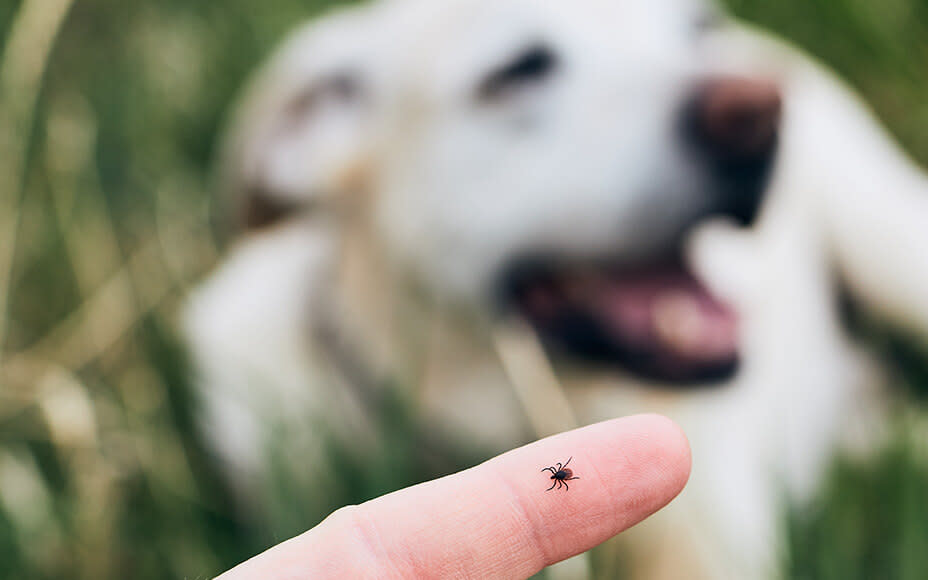
[TRANSLATION ERROR] Erwischt! Eine zügig entfernte Zecke hat in der Regel keine Zeit, deinen Hund mit Borreliose anzustecken, da rund 24 Stunden vergangen sein müssen seit dem Stich.
Once the Borrelia are transmitted, your dog's body begins to produce antibodies. However, the presence of these antibodies does not necessarily mean that your dog is actually sick, as not every infection leads to symptoms of illness. It is also possible for Borrelia to be stored in the skin and tissue, from where they can reactivate even after years and lead to illness.
But does that mean that every tick potentially transmits Borrelia? Good news: No, the transmission rate depends on the region where you are walking your dog. Especially in southern Germany, your dog is at risk of encountering a tick carrying the pathogen. But areas like the eastern parts of Saxony are also full of these pests.
Symptoms of Lyme disease in dogs
Do you suspect that your dog has contracted Lyme disease through a tick bite because you removed an engorged tick or your dog is behaving differently than usual? Rarely do dogs show symptoms immediately after transmission. Some infections remain silent or only show signs after 2 months or more. After all, only 5-10% of dogs bitten by an infected tick actually develop symptoms. These include:
- →Loss of appetite
- Lethargy
- →Fever
- Swollen lymph nodes
- Movement problems due to affected joints
- Mild redness of the skin around the bite site (rare)
Unfortunately, the symptoms are not always specific. In particular, fever and lethargy can also indicate →anaplasmosis in dogs, which is also transmitted by ticks.

Die Symptome einer Borreliose sind unspezifisch. Trotzdem ist es wichtig, dass du deinen Hund bei Anzeichen wie Fieber oder Gelenkproblemen auf den Erreger testen lässt.
Diagnosis and treatment of Lyme disease in dogs
For diagnosis, the Lyme disease test is performed in the laboratory to ensure that a disease is indeed present. A diagnosis can be made if your dog's blood shows antibodies against Borrelia. However, this only indicates that your dog has been infected with Lyme disease at some point in its life - it does not necessarily mean that there is an active disease.
If your four-legged friend shows symptoms, veterinarians assume that your dog has recently been infected and that the disease has also manifested. The usual treatment involves antibiotics (e.g., doxycycline) administered over a longer period of about 4 weeks. Borrelia are tricky creatures that tend to spread again in the body if the antibiotic is discontinued too early. The success of treatment is: The sooner Lyme disease is detected, the better the chances of recovery.
Your four-legged friend has been prescribed unpleasant pills and is far from willingly snacking on them? With our Pets Deli liver pâté, you can swiftly deliver antibiotics and other medications directly into your furry friend's body. With this delicious assistant, nothing can go wrong!


Prevention: Vaccinating dogs against Lyme disease
A good prevention against Lyme disease in dogs is essential to protect your beloved pet in the long term. Here are a few things to keep in mind:
- Tick removal: Do not simply grab the pests by the head with tweezers to remove them. It is important to →remove the tick from your dog properly using a tick removal tool or card.
- Use tick repellents: Whether spot-on, tick collars, or tablets, there are →suitable products that effectively help against ticks and protect your dog.
- Check for ticks: After every outdoor walk, you should thoroughly check your dog for bloodsuckers during tick season. Ticks discovered early have little chance of transmitting Borrelia to your dog.
The vaccine as a solution against Lyme disease in dogs?
Unlike for humans, there is a vaccine against Lyme disease for dogs. According to the Standing Vaccination Commission (StiKo), vaccination is recommended for those dogs that spend a lot of time outdoors and also live in areas at risk of the pathogen.
If a vaccinated dog is bitten by a tick carrying Lyme disease, the antibodies formed by the vaccine protect it and often prevent the disease. Since each dog produces a different number of antibodies, the vaccine does not provide 100% protection, and prevention with tick repellents is important in any case. Before vaccination, it is also necessary to ensure through a rapid test that no antibodies are already present.

[TRANSLATION ERROR] Eine Impfung ist vor allem dann sinnvoll, wenn dein Hund ein wahrer Naturbursche ist und ihr in einer Gegend wie Bayern oder der Sächsischen Schweiz lebt.
Lyme disease and late consequences: What can my dog expect?
A common late consequence when dogs contract Lyme disease is kidney inflammation. Especially if the pathogen remains undetected in your dog's body for a long time, the organs can also be affected later on. If the pathogens have already settled in the skin and tissue, it is unlikely that they can be completely eliminated with antibiotics. Often, dogs must then live with chronic Lyme disease, which is treated only when new episodes of illness with movement restrictions occur.
Since Lyme disease affects the nervous system, the disease can, in rare cases, be fatal for dogs. Therefore, thorough prevention and effective protection against ticks are essential for your dog.