What is a Hot Spot?
Almost every dog owner knows that their four-legged friend scratches themselves from time to time. This is completely normal, and you usually don’t need to worry about it. However, if your dog doesn’t stop scratching and you notice inflamed skin areas, you should promptly seek veterinary advice.
A Hot Spot, also known in veterinary medicine as pyotraumatic dermatitis or acute moist dermatitis, is an inflammation of the skin surface. The inflammation is caused by the dog itself through licking, scratching, and biting, as the four-legged friend tries to combat an underlying [→itch](/magazin/hunde/hunde-gesundheit/juckreiz-haarverlust-oder-stumpfes-fell-ursachen-fuer-hautprobleme-beim-hund).
Hot Spots are therefore not a disease in themselves, but a symptom of various causes. "Hot Spot" means something like "Hot Point," which describes the changes quite well: The affected skin areas are usually round and hot.

What symptoms occur with a Hot Spot?
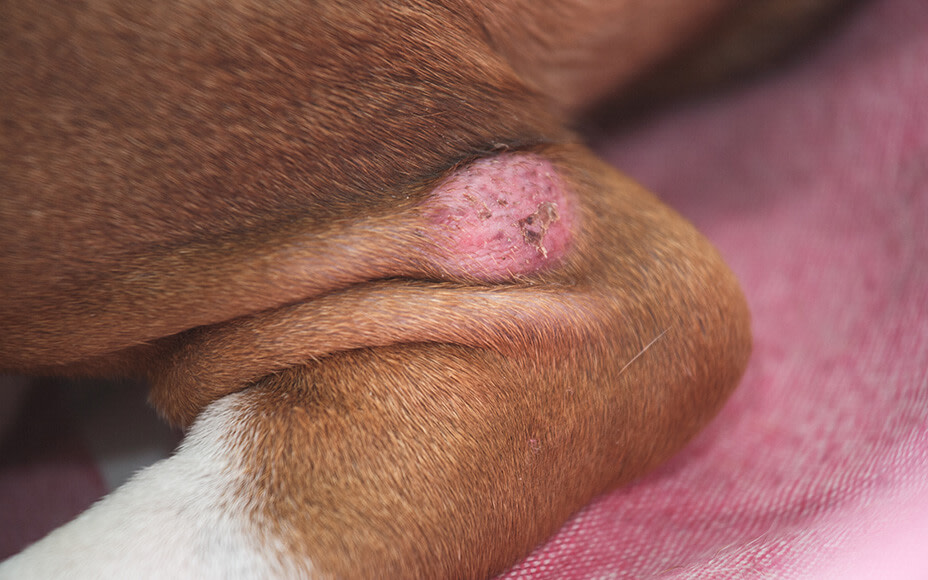
The following symptoms typically occur with Hot Spots:
- rapid development within hours
- severe itching leading to scratching, licking, and biting
- well-defined, rounded, hot
- often moist with purulent secretion
- bald spots and skin wounds
- crust formation
- eczema formation
Where do Hot Spots come from in dogs?
There are various underlying causes for the development of Hot Spots. Especially dogs with long, dense fur such as Golden Retrievers, Saint Bernards, Bernese Mountain Dogs, Newfoundlanders, or Bobtails are particularly affected.
The most common cause of Hot Spots is a flea saliva allergy. Affected dogs react with severe symptoms even with minor [→flea infestations](/magazin/hunde/hunde-gesundheit/wie-erkenne-ich-ob-mein-hund-floehe-hat).

Other causes can include:
- allergic reactions to other parasites (mites, lice, →ticks)
- food allergies
- foreign bodies in the fur
- irritating substances in the fur
- lack of grooming or matted fur
- psychological disorders
- small skin injuries
- →anal gland infections
- ear infections
- dietary fatty acid deficiency
Our high-quality →oils provide your furry friend with an extra dose of Omega-3 and 6 fatty acids and support skin and coat health.
Vitamine, Mineralien & Nahrungsergänzung für deinen Hund
How is a diagnosis made?
If you notice one or more of the symptoms in your four-legged friend, you should seek veterinary advice. The diagnosis is usually quite simple due to the typical appearance. A sterile swab of the skin can reveal the involved cells and bacteria under the microscope. Often, so-called *staphylococci* can be identified. While these are part of the normal skin flora, there is an increased colonization in the case of a Hot Spot.
It is important, in addition to diagnosing a Hot Spot, to also determine the cause of the skin changes. For this, your veterinarian will conduct further examinations.

How are Hot Spots treated in dogs?
It is important to generously shave the fur around the Hot Spots. You can imagine that this can be quite painful depending on the extent of the inflammation. Some dogs may require mild sedation to perform the shaving painlessly and safely.
After shaving, the skin changes are cleaned with a disinfectant solution such as chlorhexidine. The cleaning and disinfection of the Hot Spots must then also be continued by you at home. Your veterinarian will show you how this works and explain how often you need to treat the skin areas.
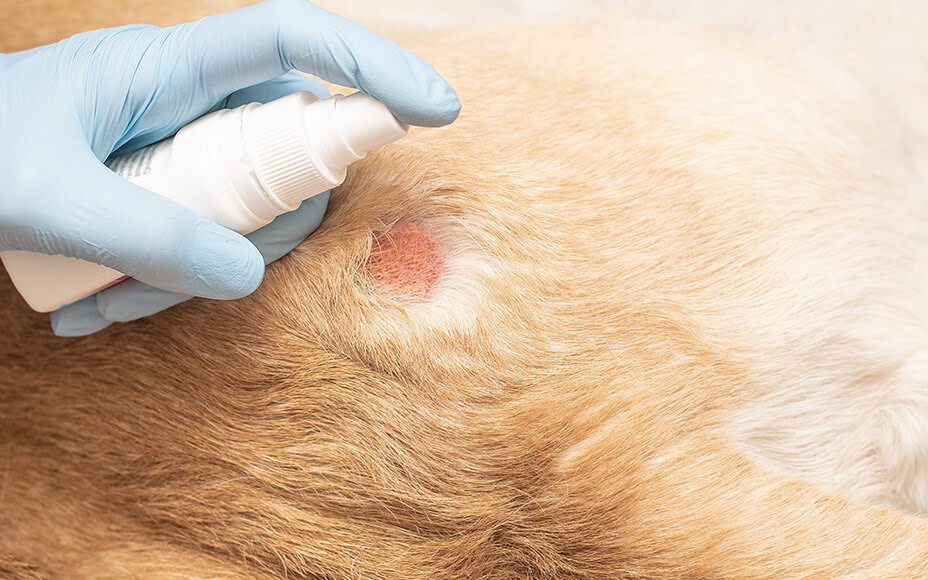
In most cases, antibiotic treatment is not necessary. Only if the Hot Spots are very pronounced and extend into deeper skin layers is antibiotic treatment advisable. To combat pain and itching, the use of cortisone is often recommended. Depending on the severity, your veterinarian may administer cortisone via injection, give you tablets, or provide a topical cream or spray to take home.
Of course, the underlying problem must also be treated. For example, if there is a flea infestation, a therapy against fleas should be initiated. A little tip: To successfully administer the flea tablet, you can hide it in our delicious →liver pâté.
What is the prognosis and what can I do for prevention?
The success of the treatment is significantly influenced by your home care. Follow the veterinarian's instructions and remember that hygiene is particularly important.
Most Hot Spots heal within a few weeks, and the prognosis is good. Depending on the underlying condition, Hot Spots may unfortunately recur. It is important to know and treat the root problem.
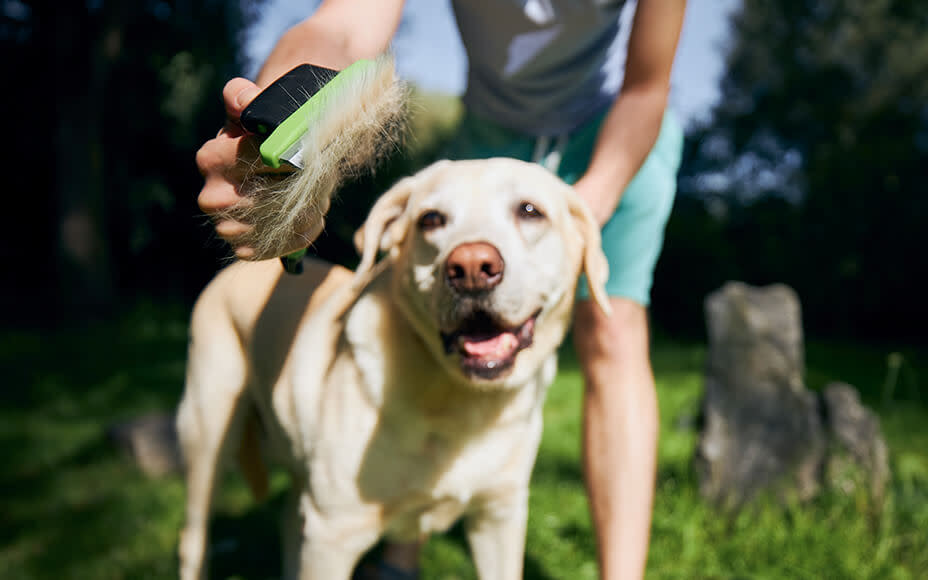
Since a flea saliva allergy is the most common cause of Hot Spots, adequate flea prevention is essential for successful prevention. Additionally, you should →regularly brush the fur and free it from mats, especially in long-haired dogs.
Keep a close eye on your four-legged friend, and if you notice that the scratching is increasing again: Off to the veterinarian!