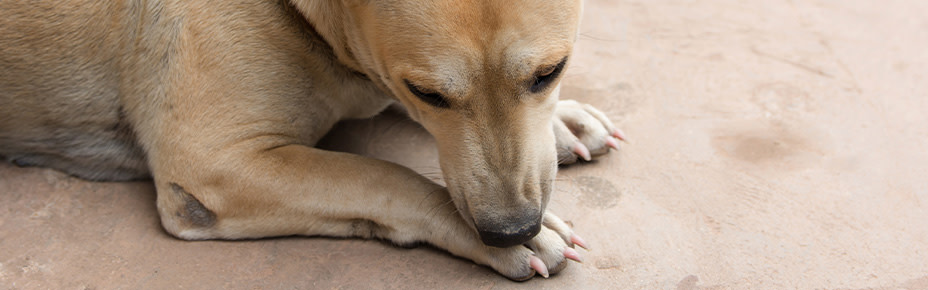
Is it normal for my dog to lick its paws?
Does your four-legged friend lick its paws from time to time or maybe gnaws at them a bit more intensely? This is generally not a cause for concern. If it itches on the paws, your dog can only "scratch" there by licking or gnawing and thus provide relief. Even if some dirt has accumulated on the paws and between the individual toes, some particularly clean dogs try to lick themselves clean.
When is paw licking problematic?
However, you should be alert if your dog licks and gnaws at its paws more often than usual and/or several times a day for a longer period. On one hand, this behavior can be a sign that something is wrong (illness, stress). On the other hand, constant licking destroys the skin barrier. Consequently, inflammations can occur on the paws, which in turn promote the proliferation and penetration of bacteria and fungi. An even stronger itching is the result, leading to even more paw licking, which naturally leads to an ever-increasing deterioration of the skin and can lead to →licking eczema.

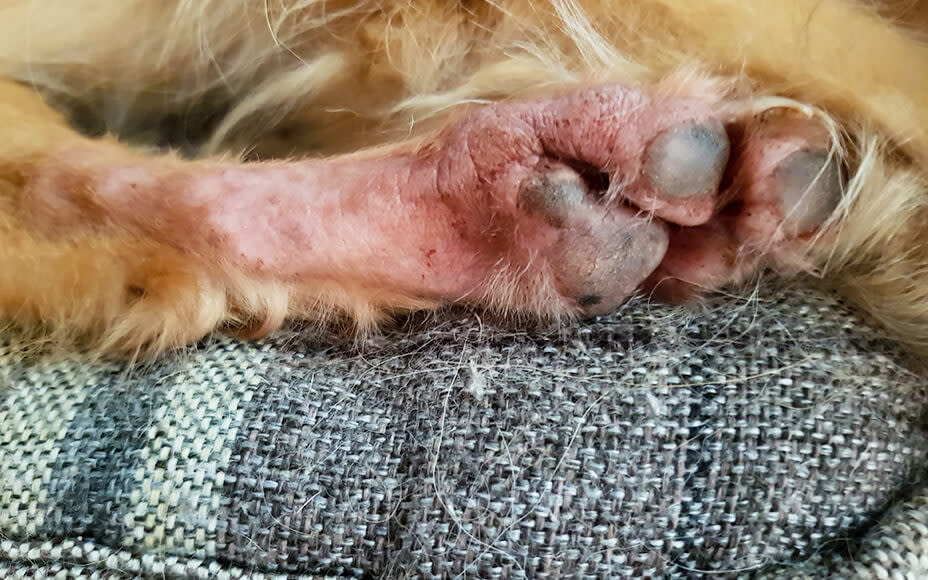
[TRANSLATION ERROR] Exzessives Pfotenlecken kann zu schlimmen Entzündungen der Pfoten führen. Deswegen ist es wichtig, die Ursache zu finden!
To break this vicious cycle, you should get to the bottom of the cause of the licking and gnawing of the paws. Common causes include:
Intolerances or allergies
→Allergies and intolerances, for example [→to the usual food](/magazin/hunde/hunde-gesundheit/futtermittelallergie-beim-hund-das-kannst-du-tun) or even to grasses or mites, can lead to severe itching and thus to paw licking. Other signs are usually hair loss, open skin areas like licking eczema or →hot spots and ear infections.
An allergy to grasses or mites can be well treated with the right medications. In the case of a food allergy, usually only an elimination diet helps, and ultimately a switch to, for example, a hypoallergenic food.
Sensitive and itch-free through life: With our hypoallergenic food, we ensure joy in the bowl - because enjoyment should not be neglected even for sensitive four-legged friends!
Juckreiz ade: Unsere unwiderstehlichen Sensitiv-Sorten


Parasites like autumn grass mites
Parasites are pesky little creatures that our four-legged friends can catch almost anywhere. However, especially the autumn grass mite troubles our dogs in the late summer between July and October. While our four-legged friends happily roam through meadows and fields, fully grown autumn grass mites make themselves comfortable in the fur of their paws. The adult parasites themselves are harmless to our dogs. However, their larvae leave a salivary secretion that can trigger severe itching in the affected dogs. The result: The animals start licking their paws.
Parasites like the autumn grass mite can usually be well treated with a suitable antiparasitic.
Strong proliferation of yeast fungi
Just like in humans, yeast fungi live on your four-legged friend's skin. These are generally harmless and do not cause further issues. However, if the skin flora of your four-legged friend is disturbed, for example, by an allergy or frequent licking, the yeast fungus can proliferate strongly and thus cause itching. Successful treatment here involves washing with a special medical shampoo.
Especially dog breeds with wrinkled skin like the →Shar Pei or →Pug are more frequently affected by skin diseases caused by yeast fungi. Special attention should be paid to hygiene in the skin folds. Our Deep Clean Shampoo has antibacterial properties and supports with skin problems. With its all-natural ingredients and pH neutrality, it is excellent for all sensitive fur noses!
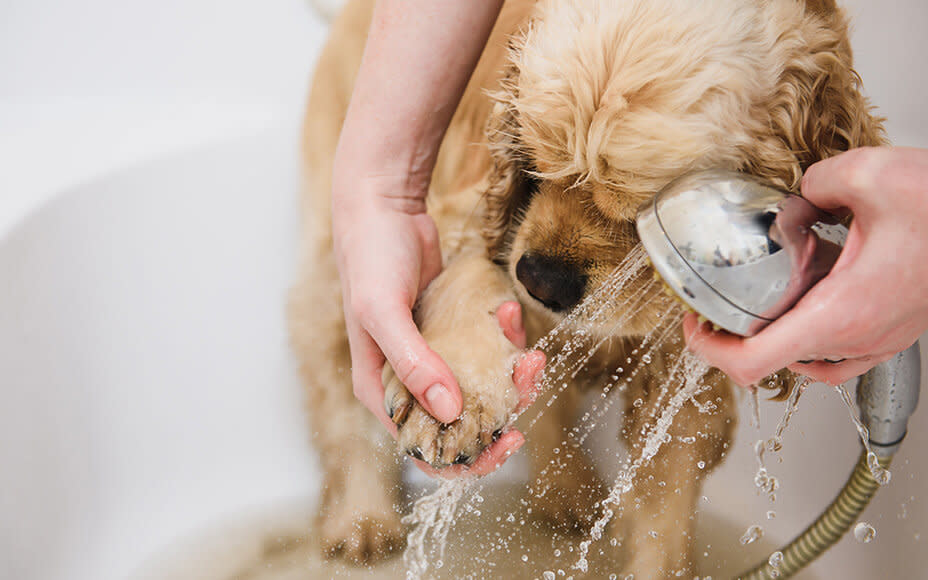
[TRANSLATION ERROR] Hefepilze können mittels der richtigen Fell- und Hautpflegeprodukte gut behandelt werden.
Skin fungi
An infection with a skin fungus is usually accompanied by (circular) hair loss and severe itching. A veterinarian can diagnose and treat a skin fungus. Here, too, a special medical shampoo helps.
Note that skin fungi can be contagious and can thus be transmitted to other animals living in the household or even to children and adults.
Psychological problems
Not infrequently, behavioral abnormalities, such as increased licking and nibbling at the paws, indicate a psychological problem. Before that, you should have your four-legged friend checked by veterinarians, and if physical causes are ruled out, you can also consult dog trainers or behavior therapists.
Especially sensitive and nervous dogs can become quickly stressed and then tend to excessively lick their paws. This is somewhat comparable to nail-biting in some people. In severe cases, the dogs are so stressed that they exhibit self-destructive behavior through excessive gnawing and biting into their paws. For this reason, it is important to find out why your dog exhibits this behavior and to work together on the cause.
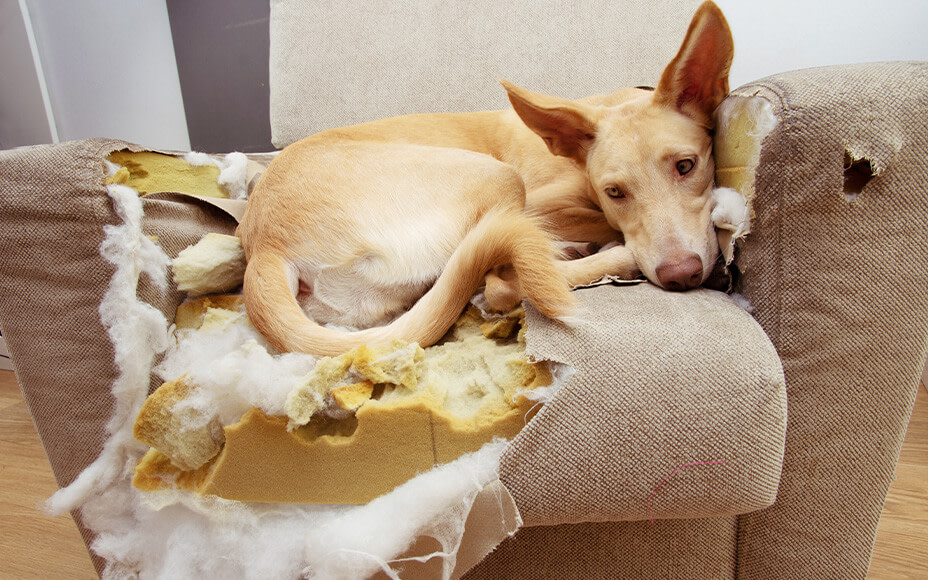
[TRANSLATION ERROR] Ein gestresster Hund zerstört gern einmal Gegenstände - oder sich selbst durch exzessives Lecken und Nagen an den Pfoten.
Foreign bodies in the paw
Observe whether your dog only licks a specific paw? Then a small foreign body stuck could be the reason for the constant licking. In summer, for example, many four-legged friends quickly step on a grain awn. This is not only unpleasant for our dogs, but it can also become dangerous. Once under the skin, awns can migrate through your dog's body and cause severe inflammations.
Also, a thorn, a small stone, or other hard, sharp objects can embed themselves in the skin of the paws. If you cannot see or feel these and thus cannot remove them with tweezers, have your dog examined by veterinarians. They can better identify the foreign body with magnifying glasses, apply a pulling ointment, or surgically remove the intruder through a small incision.
Matting of the fur
Especially in →long-haired dog breeds, the fur on the paws can also become a problem. Faster than expected, the hair on the paws grows long, becomes matted, and forms small knots. This is very unpleasant for our four-legged friends and can be associated with pain and skin inflammations. If you have a breed with long hair, such as a Poodle or Doodle, regularly checking and trimming the paw fur is part of regular grooming.