How to Properly and Healthily Feed Your Young Cat
When your little furball first sets its tiny paws in your home, it’s clear: A new family member now resides here. By now, you should have found the answer to the question of proper and healthy nutrition for your kitten. What nutrients should you pay attention to, and how much does such a small cat actually eat in a day?
How often should I feed my kitten?
During the kitten phase, young cats receive five to six or even more small meals a day. Until the sixth month, this feeding with multiple small meals is recommended; after this age, you can reduce the frequency to two or three meals daily - but not the amount! Some owners continue to give their cats multiple meals even at an older age instead of just a few larger portions. This approach is closer to the natural eating behavior of cats, as wildcats also consume several rations throughout the day - up to 20 meals in a 24-hour period.

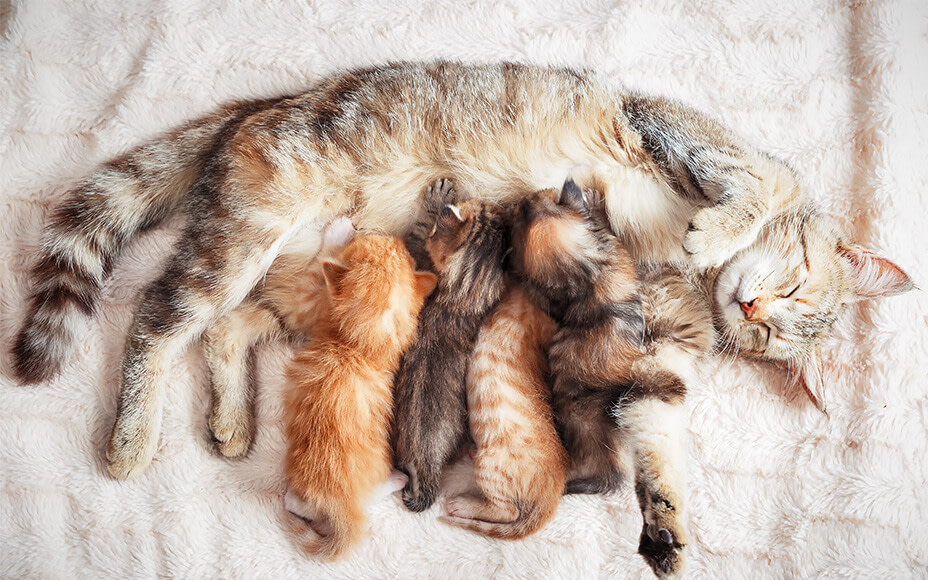
[TRANSLATION ERROR] Sowohl beim Muttertier als auch in freier Wildbahn nehmen Katzen viele kleine Mahlzeiten zu sich.
How much cat food does a kitten need per day?
You can find out how much food should be in a meal for complete feeds, like those commonly found as →BARF, wet, or dry food, from the feeding recommendation. Here’s how to proceed:
1. Determine your cat's weight. You need this to read how much your cat is allowed to eat from the table on the food package.
2. Research your cat's expected adult weight. For cat breeds, you can easily find out how much your cat will weigh through internet research or by calling breeders. Why is this important? In the →feeding recommendations, the rows and columns meet at the feeding amount that is best for the current weight and the expected adult weight. This ensures that your kitten is provided with all the necessary nutrients.
3. As a final step, just look at the table for the feeding recommendations and take the correct amount. Note: This is the daily amount. You divide this by the number of meals you want to feed your young cat. For example, with our delicious →Junior wet food sauce menu with turkey and pumpkin:
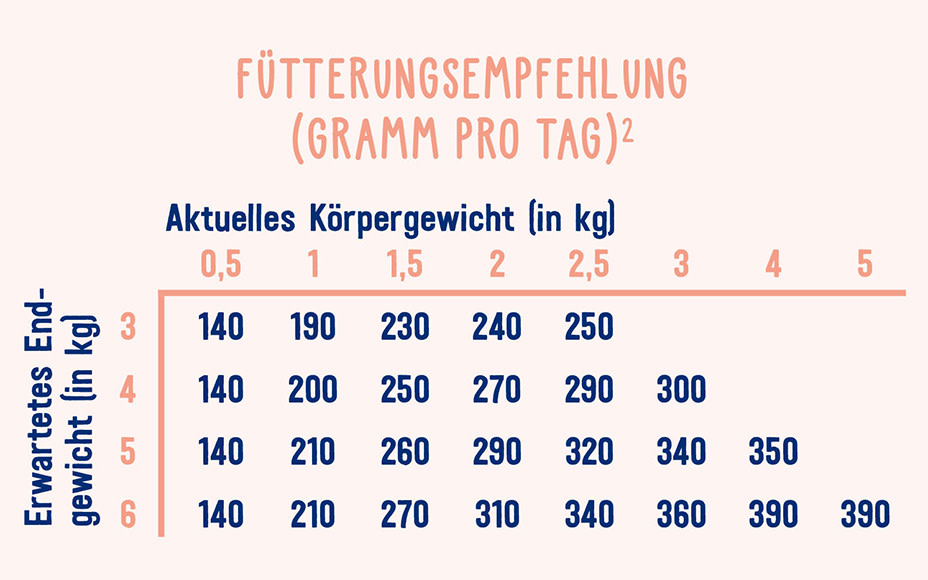
[TRANSLATION ERROR] Auf dem Futter deiner Katze findest du genaue Angaben zur Fütterungsmenge, an die du dich in jedem Fall halten solltest.
Your kitten currently weighs 0.5 kg and has a target weight of 4 kg. Then the correct daily feeding amount is 190g. As you have learned, your four-legged friend should not eat all of this at once. With seven meals per day, we divide the feeding amount of 190g by the number of meals, which is 7. 190g divided by 7 results in about 27g for each of the seven meals. At first glance, this seems small, but it is optimal for such continuous feeding of growing cats.
Please refrain from increasing the amounts on your own because you want to please your kitten. Also, added minerals have no place in kitten food. Healthy kittens gain about 100 grams per week. If your little cat is significantly above or below this value, you can easily adjust the food amount in consultation with veterinarians.
For a healthy start in life: We at Pets Deli have created the tastiest meal for your young furball. And the best part? Our junior food provides your young four-legged friend with important proteins, vitamins, and minerals, as precise composition is very important for growing cats.
The Best Start to a Four-Legged Life: Discover Our Healthy Junior Food
What food should you feed kittens and young cats?
To best support the rapid growth of your cat's bones and organs, it is essential to choose a →good kitten food. This contains certain nutrients in higher amounts than adult food; for example, the protein content is up to 10% higher than in food for adult animals.
We at Pets Deli recommend feeding junior food until the 12th month. By then, the most important processes of the growth phase are completed, and your pet's body no longer relies on higher doses of nutrients. Then you should switch to adult cat food.
You want only the best for your furry friend - however, you should refrain from taking the initiative regarding dietary supplements and adding more nutrients to your cat's food. A good junior food already contains the perfect dose of nutrients, and your cat is well-equipped for healthy bone growth.
Wet food or dry food for kittens?
Are you wondering why there is both wet and dry food in the range and which is better suited? There are some advantages and disadvantages to both feeding types. For many cats, the →different consistencies of wet food are not only more attractive, but wet food also has decisive advantages for the water balance of cats - as they are often poor drinkers. Wet food provides much more moisture and covers most of the daily needs of cats. Dehydration is a serious issue, as it can lead to urinary and kidney diseases. However, wet food must always be served fresh and stored in the refrigerator once opened. In contrast to dry food, it has a higher protein content but must also be fed in larger amounts due to a lower carbohydrate content.
Dry food can easily be divided into small portions - and as you just learned, this is also important when it comes to species-appropriate feeding. Many owners are also fans of the practical bags that are easy to reseal. One option is the mixed feeding, where cats receive some meals as wet food and can also snack from a bowl of dry food throughout the day. Here, be sure to calculate the feeding amount based on both recommendations so that your cat is not over- or underfed.
Changing food for young cats
When your kitten moves into its new home, a lot happens: away from mom and siblings, and everything else is new. Different smells, unfamiliar faces, and you might already be thinking about a new food. This is completely legitimate - perhaps the breeder's food does not match your ideas of a healthy cat food, and you want to feed your darling the best of the best as soon as possible. Here, the rule is: Always take it easy.
Continue to feed your kitten the food from the breeder or shelter for a few days before you start →switching to a new food. After that, you can start mixing a portion of the new food with the old - this can happen regardless of the type of food. If your cat is only used to wet food and you want to switch to dry food, this is usually not a problem.
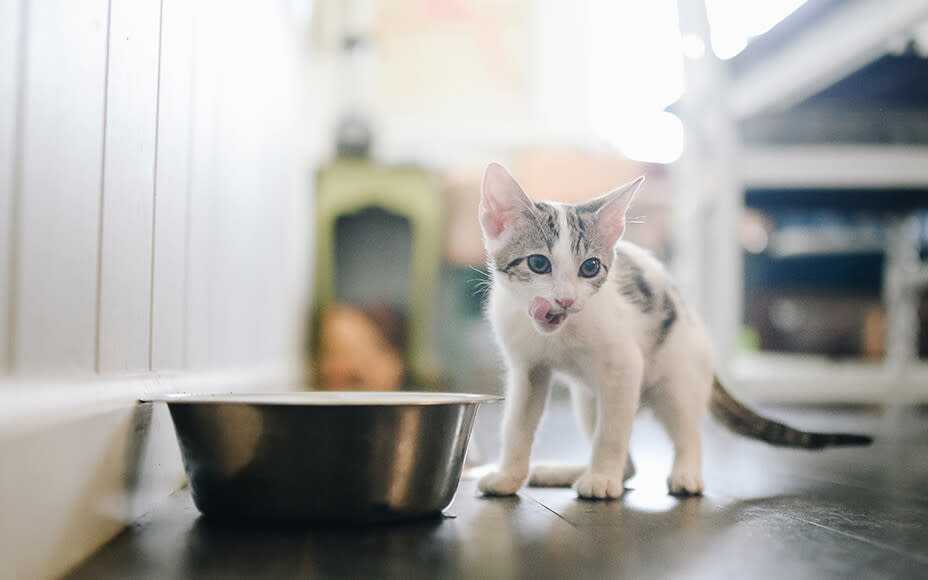
[TRANSLATION ERROR] Dein kleiner Vierbeiner ist eben eingezogen und am liebsten möchtest du jetzt sofort das beste Futter für ihn? Geduld ist hier wichtig, denn dein Vierbeiner muss jede Menge neuer Eindrücke verarbeiten.
Help, my cat is not eating anymore
Life with your new kitten is exciting not only for you. This new phase also brings many changes for your little treasure, which can affect its appetite especially at the beginning. There’s a lot for your four-legged friend to process, leaving no time for eating. Additionally, other factors can also influence your cat's eating behavior and cause →loss of appetite:
- Teething: If your darling refuses dry food or harder snacks, teething may be the cause. During the phase when your darling loses its kitten teeth and new ones grow, it may have difficulty chewing hard food. During this time, you can offer it food with a softer consistency.
- Too much of a good thing: Some kittens could seemingly handle two more portions, while others are more than satisfied with their daily rations. If your darling generally eats but always leaves some food in the bowl, you can slightly reduce the amount of each portion and instead feed more smaller portions.
- The wrong bowl: If your kitten does not eat from the bowl but rather from the floor or your hand, the type of bowl may play a role. It may be difficult for your four-legged friend to eat from the existing bowl. Both the size and type of the bowl can be important. Cats prefer to eat from shallow bowls and as far away from their water bowl as possible.
- Training: You can rarely resist the big, round eyes of your kitten, and it usually gets everything it wants? This can be detrimental in many cases, including during feeding. If your furball has learned that rejected food will be replaced with something else, it will remember this and hope for a food change when it doesn’t touch the bowl. Here, you should not give in directly as part of the →training, as cats are picky eaters.
When your kitten gets hungry, it will eat the food sooner or later and realize that the decision about the food lies with you. Constantly giving in and changing the food can lead to →behavioral problems, where your little cat turns the tables on you. If your little treasure refuses its food for an extended period, you can try a new one.
Snacks during the kitten phase
No question - especially during your getting-to-know phase, treats play a super important role. In general, treats are practically allowed from day 1. However, it depends on the type, quality, and ingredients.
We recommend starting with non-fat, easily digestible snacks and not jumping straight into tripe. Your kitten's stomach is still growing and is particularly susceptible to various digestive issues.
Make sure that the size of the treat is appropriate for the size of your furry friend so that it does not choke. You should also pay attention to the ingredients of the snacks: sugar not only harms the teeth but is also suspected of promoting diseases such as diabetes mellitus and obesity. Other additives like coloring and flavoring agents have no place in a healthy snack.
Your little furball can snack through our range and find out what it likes best. Our snacks are guaranteed to be free from sugar, grains, and artificial additives!