
The Most Common Emergencies in Cats
Not every emergency is immediately recognizable – but many follow the same patterns. If you know what to look for, you can react quickly.
Here are the most common emergencies in cats:
Poisoning
Typical after contact with plants, cleaning agents, or medications. Symptoms: excessive salivation, vomiting, trembling, seizures, or lethargy.Injuries and bite wounds
Often after a fall or a fight with other animals. Look for blood, limping, or sensitive areas.Heatstroke
Occurs mainly in summer – e.g., during transport in a hot car. Symptoms: panting, unsteady gait, red mucous membranes, lethargy.Burns
Possible from hot stove tops, candles, electrical cables, or walking on hot asphalt. Usually visible through reddened or open skin areas, rapid breathing.Difficulty breathing
Can be triggered by allergic reactions, foreign bodies, or heart problems. Symptoms: open-mouth breathing, bluish tongue, panic behavior.
Each of these situations can be life-threatening – even if your kitty still seems "normal." When in doubt: better to act immediately.


Warning: poison hazard! Many plants and household products are highly dangerous to cats – poisoning is one of the most common emergencies.
What You Can Do Immediately
Stay calm – it sounds trivial, but it is crucial. Cats sense stress immediately. So: take a deep breath and act quickly but thoughtfully.
First steps in emergencies:
Create a safe environment
Remove other animals, hazards, or curious children. Place your cat on a non-slip surface in a quiet location.Observe symptoms
Is she breathing normally? Is she responsive? Are there visible wounds or bleeding? Your veterinarian needs this information.No self-experimentation!
No home remedies, no medications without consultation. Do not induce vomiting, apply ointments, or use cold water on burns.Contact a veterinarian or emergency pet service immediately
Describe the situation and follow the instructions. Many practices have emergency numbers – it's best to save them in your phone in advance.If you need to transport
Use a sturdy carrier, secure it in the car, and ensure good ventilation. Depending on the cat's condition: keep warm or cool slowly (e.g., in case of heatstroke).
In short: Don’t hesitate, don’t Google – act. Every minute can be crucial.
Checklist: First Aid Kit for Cats
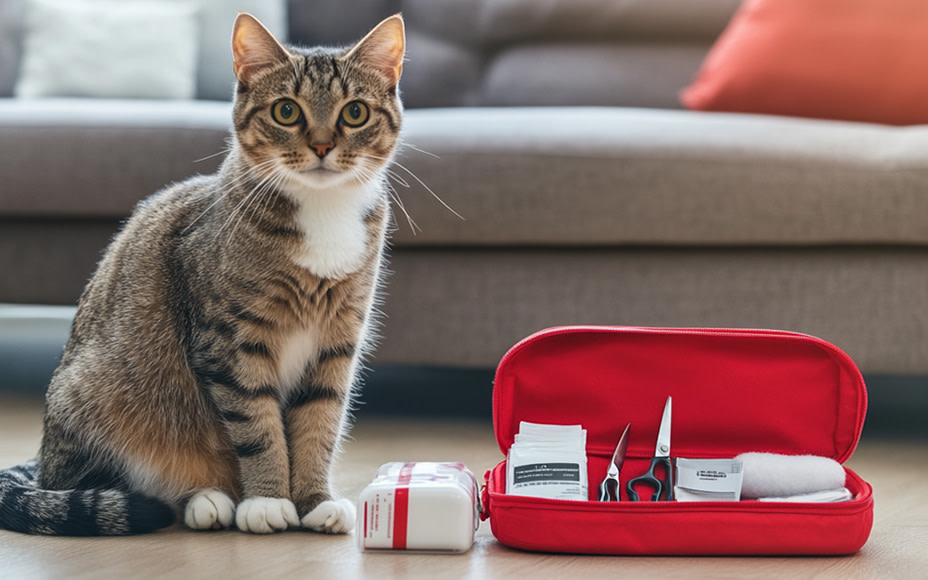
A well-equipped first aid kit helps you respond calmly and quickly in an emergency. You should always have these items on hand:
Sterile compresses and gauze bandages
Self-adhesive bandages
Small scissors with rounded tips
Tick tweezers or tweezers
Disposable syringe (without needle)
Sterile eye wash solution
Digital thermometer for →measuring fever
Iodine-free disinfectant solution
Disposable gloves
Large towel (for securing)
Emergency card with phone numbers (veterinarian, animal clinic, poison control)
Store everything together in a fixed location – dry, accessible, and regularly checked. In an emergency, not only does it matter what you have, but also how quickly you can find it.
When You Need Veterinary Help – and How to Decide Correctly
Sometimes the situation is clear: heavily bleeding wounds, difficulty breathing, or seizures – there’s no time for deliberation. But what about the moments when you’re unsure? When your cat seems "just" a bit lethargic or suddenly stops eating?
The rule of thumb is: Better to call too often than to wait too long. Even if you’re not a professional – your gut feeling matters. You know your cat better than anyone else. If something doesn’t seem normal, it probably isn’t.
When in doubt, contact the nearest veterinarian and describe the situation. Many practices offer telephone assessments. And for evenings, weekends, or holidays, it’s worth saving the emergency pet service number in your phone – as well as the address of the nearest animal clinic.
One last tip: Keep a note or screenshot with important information handy in an emergency – vaccination status, current medications, weight of your cat. This can save valuable time in the practice. Additionally, many organizations, such as Die Johanniter or Malteser, offer first aid courses for pets. In these courses, you will learn practically what measures you can take to provide first aid to your four-legged friend in an emergency.