
How can cats get worms?
Worms live differently than →fleas or →mites, inside your cat and are therefore often only discovered when your kitty has already been infested for a longer period of time and shows symptoms. To best prevent a worm infestation, it’s important to understand how your cat can actually become infected with worms:
Transmission usually occurs through the ingestion of worm eggs. It’s enough if your cat sniffs, licks, or eats things that are contaminated. Outdoor cats in particular spend more time in "risk areas" and often sniff or lick feces, animal carcasses, or soil that are infested with worm eggs. But they can also become infected by infected birds, mice, or other small animals that your outdoor cat likes to catch.

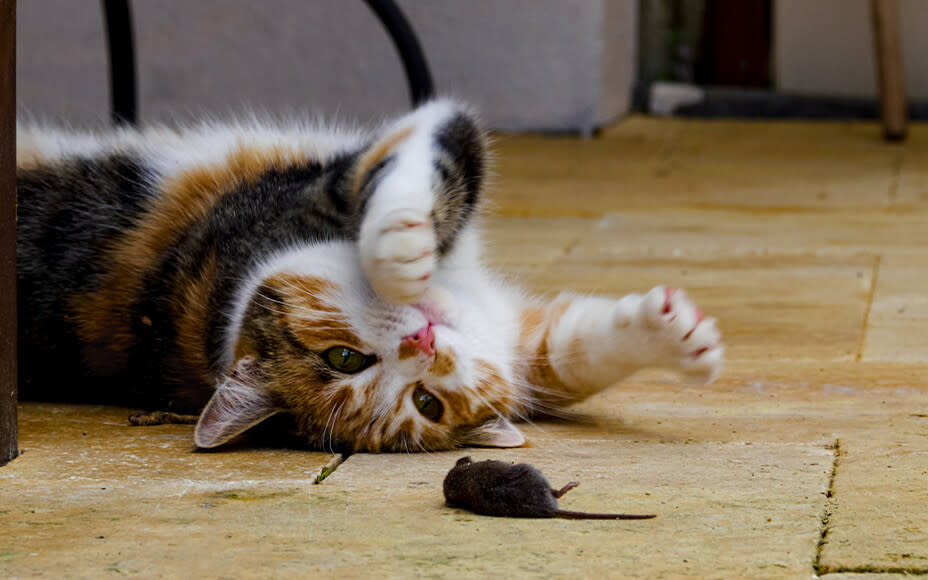
Just one lick of infected birds, mice, animal feces, or even grass can be enough for your cat to get worms.
Through the mouth, the eggs then enter the intestines of your feline friend and the reproduction process begins. The eggs quickly develop into larvae, which can spread through the blood vessels of your cat throughout the body, such as the lungs or muscles.
Note that even strictly indoor cats can get worms. By bringing in eggs on your shoes or by feeding →raw meat such as ground beef for example, your indoor cats can become infected with worms just as easily. That’s why you should always maintain good hygiene with your cat’s water and food bowls and feed fresh, high-quality cat food.
Our cat food: honest, healthy, delicious.
How can I tell if my cat has worms?
Whether your kitty has caught a →tapeworm or a →roundworm, the symptoms are quite similar and usually only appear when the worms have already settled in. Watch out for the following signs:
→dull coat and hair loss,
a bloated belly,
→diarrhea and vomiting,
→loss of appetite and possibly weight loss.
With tapeworms it’s also worth taking a closer look at the stool, even if it’s a bit unpleasant. If you can spot small white specks in the feces, this can be a sign of tapeworms. If your cat vomits or coughs a lot, you should also take a closer look at the discharge. Here, white threads, that look like spaghetti, may indicate a roundworm infestation.

Outdoor cats in particular can quickly become infected with worms, although indoor cats can also be affected.
How are worms treated in cats?
If your cat has been examined by a veterinarian and the diagnosis of which type of worms are present has been made, treatment can begin. Worm infestations are often treated with a suitable medication in the form of chewable tablets. Some also administer deworming pastes. In more severe cases, additional supplements, infusions, or injections may be given.
To make sure your cat actually eats the tablet and doesn’t pick it out of the bowl, sometimes a few tricks are necessary. With our delicious cream snacks for example, you can easily get a tablet into your cat without her noticing.

Creamy, tasty, and the perfect snack for in between, for administering medication, or during training.
How can I prevent my cat from getting worms?
One thing up front: There is unfortunately no hundred percent protection against worms. Most of the time, worm eggs are ingested faster than your cat can say "meow." The good news is, however, that there are several ways to effectively and →such as ticks prevent worms and other parasites easily.
These include prophylactic and regular deworming as well as consistent flea control – especially if your cats are outdoors. In addition, food bowls, sleeping areas, and litter boxes should always be kept hygienically clean. If there are other animals in the household, they should also be regularly checked for parasites and treated if necessary.