What is a dog crate anyway?
Many dog owners only come into contact with a dog crate when their four-legged friends →have difficulties relaxing and [→being alone](/magazin/hunde/hunde-erziehung/trennungsangst-so-kannst-du-deinem-hund-helfen). It's actually quite a shame, because a crate can be a safe and practical retreat for your dog. A dog crate is essentially a type of dog house for indoors. It is usually made of fabric, steel, or plastic. Fabric models have the advantage of being foldable, making them easier to take along on vacation - like a home to go.
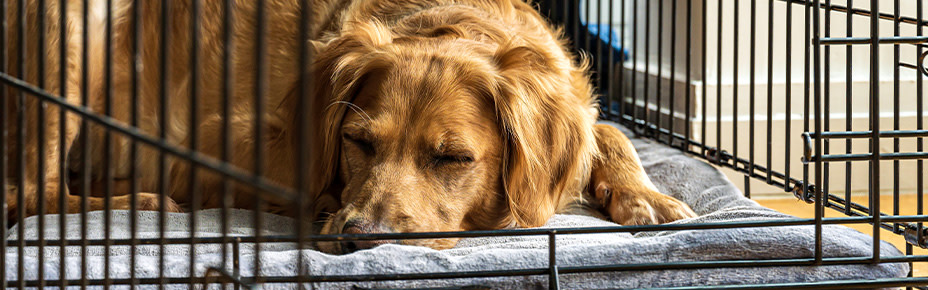
The dog crate is used as a resting place and lying area for the dog. Especially sensitive or insecure dogs can calm down better in a crate, as the walls and ceiling act like a cave and shield from environmental influences. A crate can also be quite practical for puppies, as they are usually still very curious and have a hard time settling down, but need →a lot of sleep.

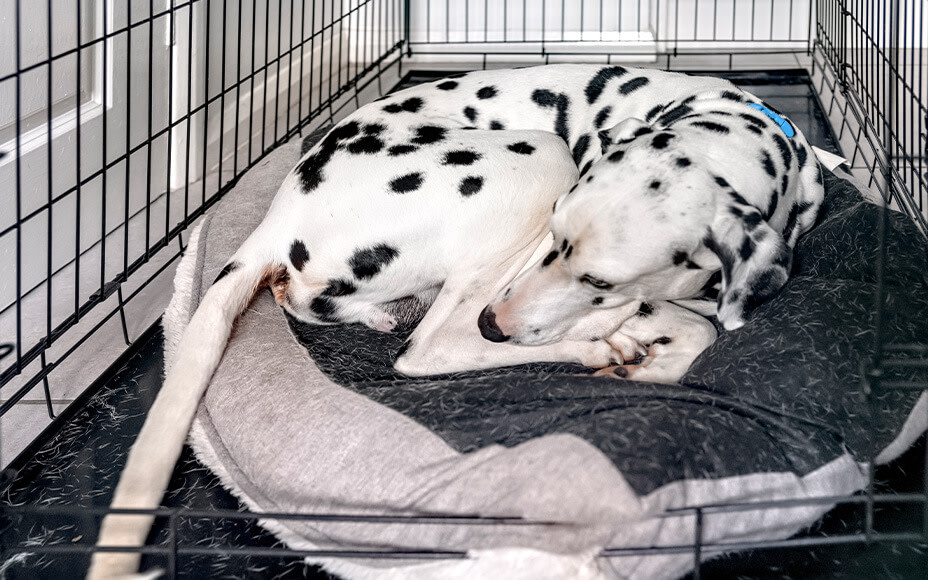
[TRANSLATION ERROR] Eine Box kann ein sicherer Rückzugsort sein, wo dein Hund gut zur Ruhe kommt und schläft.
What types of dog crates are there?
Depending on what you need the crate for, there are various models and materials available. Typically, dog crates are offered in fabric, plastic, and steel.
If you need a crate for a transitional step in training or as a travel basket, a simple fabric crate may be sufficient. If you need something more robust for your dog, for example as a safe →transport crate for the car, special car crates made of steel are more advisable. Crates made of plastic are a good middle ground. While they cannot be folded like fabric crates, they are lighter than metal crates and can therefore also be easily taken on vacation or to the vet.
Does your dog love its crate? Then you can integrate it permanently into your home by, for example, converting a cabinet into a dog crate. Your dog can lie down in it at the bottom, and you can place things on top - this way, the dog crate harmoniously fits into your decor.
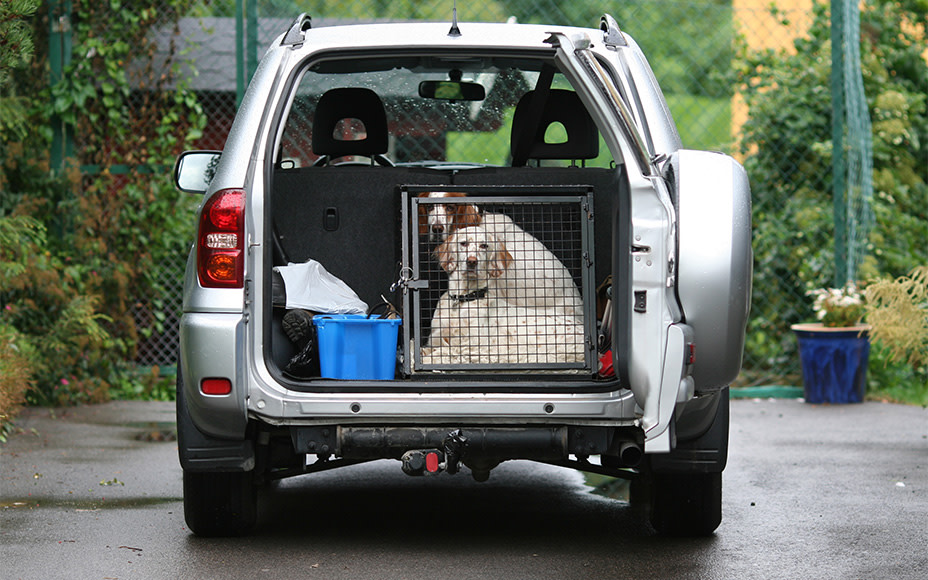
[TRANSLATION ERROR] Zum Autofahren sind spezielle Transportboxen aus Stahl am sichersten. Hier ist dein Hund auch geschützt, sollte es mal einen Unfall geben.
Crate training: Build a positive association with the crate in 6 steps
It is important that the crate is not misused as a punishment or for confinement. A dog crate should be a safe retreat for your dog, not a prison. However, it may be that some dogs need a little encouragement to find the crate appealing. Especially very clingy and insecure dogs or little "control freaks" may initially find a crate quite annoying, as they can't see everything as well and are forced to calm down. So you see: Some dogs benefit immensely from a crate in the long run.
So grab a handful of tasty treats and let's get started!
Tolle Belohnungen für fleißige Hunde - unsere Snacks
Step 1: Let the dog explore the crate
At first, the crate is something neutral for your dog. Some dogs love it from the start and jump right in, while others only sniff at it skeptically and voluntarily don’t put a paw inside. Nevertheless, you should let your dog explore the crate calmly and praise any interest shown.
Step 2: Toss treats into the crate
Now you can help a bit by throwing a few treats into the crate that the dog can retrieve. Place the treats first towards the front of the crate, and later you can throw them towards the back, so your dog has to take a step into the crate to get the treat. Make sure that the crate door cannot close by itself. Repeat this a few times until your dog has shed its skepticism towards the crate and happily retrieves the treats.
Step 3: Introduce a signal
Once your dog is calmly retrieving the treats from the crate, you can start to introduce a signal word or command for the crate. Because later, you might want to send your dog to its place with a "Go to the crate." To do this, place the treat at the back of the crate, your dog goes in, and at that moment, you say the command "Crate" or "Go to the crate" or whatever you want to call it. Repeat this step a few times as well.
Step 4: Repeat the signal
After you have repeated the signal word a few times, you now say first the signal word, let your dog go into the crate, and then give him his reward in the crate afterwards. This is a very important step. If you notice that your dog does not go into the crate on its own after the command but waits for you to place the treat inside first, take a step back in training.
Step 5: Extend the time in the crate
Of course, your dog should stay in the crate for a bit longer than just a few seconds to get its reward. Therefore, in the next step, you can extend the duration in the crate. Send your dog into the crate with the signal word, wait a moment, give him the reward, and then release him from the crate. This way, you can gradually extend the time your dog spends in the crate and slowly reduce the treats.
A good trick is to give your dog a chew treat in the crate from time to time, as this will naturally keep him in the dog crate longer while he chews on his snack. For this, our →salmon-beef rolls are particularly suitable. The dried salmon skin makes the chews taste especially intense, and the beef skin provides long-lasting chewing fun. We are sure: Your dog will happily nibble on it in the crate.
Bite-resistant chew snacks for every chewing pleasure!
Step 6: Introduce movement
Once your dog can relax in the crate for a while, practice walking around the room, sitting on the sofa, and maybe even briefly leaving the room. It is important that your dog learns to stay in the crate and remain calm even when there is movement and activity in your home. If your dog wants to leave the crate, gently but firmly send him back into the crate. Alternatively, you can also practice closing the dog crate.
How big should the dog crate be?
You should always choose a dog crate that is large enough for your four-legged friend to lie down comfortably, stand up, and turn around. However, it should not be too big, as too much space can lead to less security and stability.
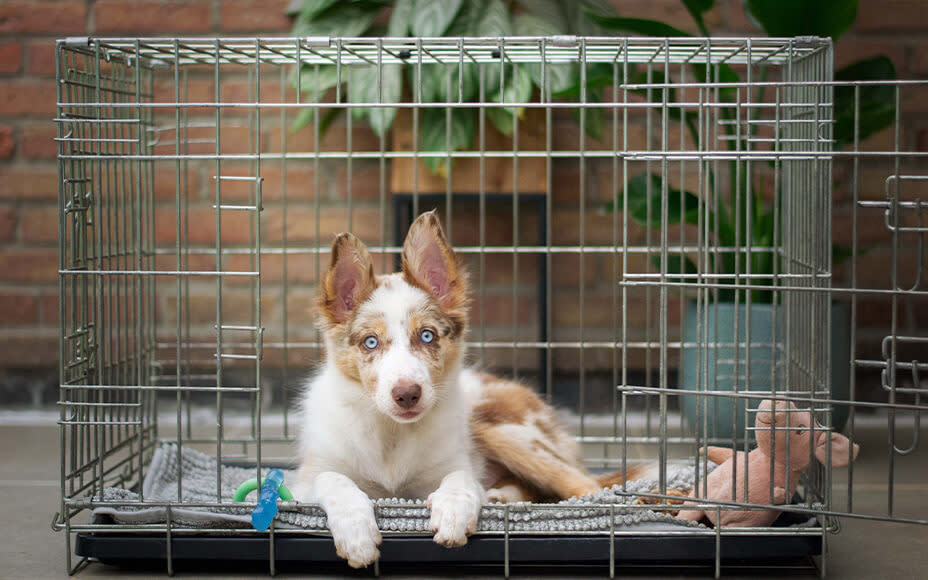
[TRANSLATION ERROR] Optimalerweise ist die Box so groß, dass dein Hund darin ausgestreckt liegen, sich hinstellen und herumdrehen kann.
When should I close the crate?
So far, we have set up the crate like a normal basket, just with walls and a roof. Many people think of a dog crate as a place to send the dog, close the door, and leave him there. However, you should never set up a crate this way or simply lock your dog inside! A dog crate is not a place to confine the dog or a quick solution when he is being annoying. Nevertheless, you can close the crate if you wish. This step should also be built up gradually:
If you have practiced the previous steps well and your dog can relax in the crate, you can now start by briefly leaning the door against the crate, then immediately opening it again and rewarding the dog. Repeat this a few times and extend the time you lean the door against the crate. If your dog is relaxed, you can close the door properly, wait briefly, and then open it again. Reward your four-legged friend afterwards. In the last step, you can close the door and throw treats through the bars or a small hole in the zipper inside.
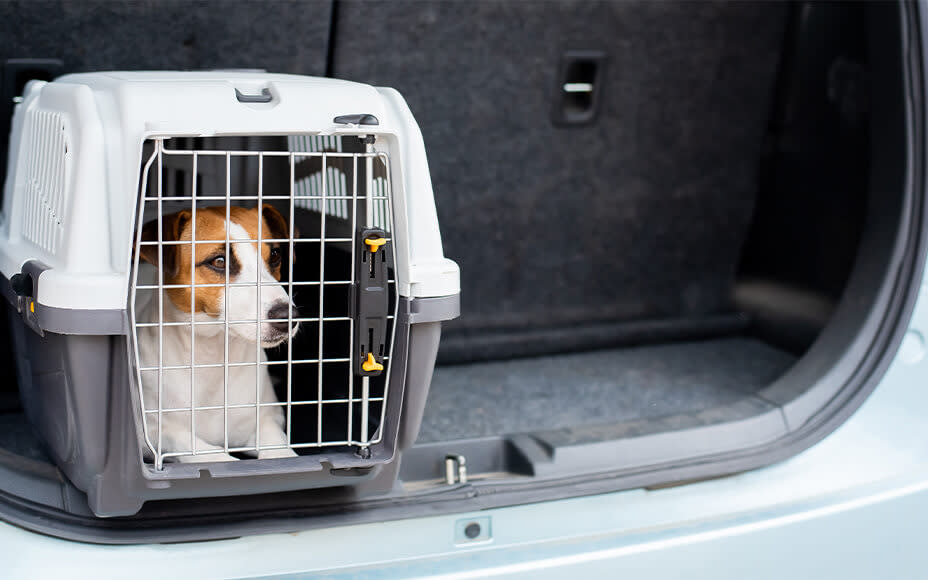
[TRANSLATION ERROR] Wenn du mit deinem kleinen Vierbeiner zum Tierarzt musst, kann eine Box nicht nur beim Transport helfen - sie spendet auch Sicherheit!
Building up the closing of the crate is especially important if you want to transport your dog in a dog crate in the car or if he needs to go into a crate at the vet. Also, for puppies, closing the crate can be useful, as they usually do not yet understand how to respect spaces. Uh... Respect spaces? Exactly, placing the dog in a crate or on its bed is a spatial assignment from you. You want your dog to lie down there and, of course, stay there and ideally calm down. Therefore, we recommend that you also establish a release command for the dog crate.
Release command: Let the dog out of the crate on command
Dogs that are always waiting for something to happen or are watching you and tracking your every movement usually have a hard time relaxing. Sending them to a crate doesn't help much at first, as they will likely wait for a treat and then just march out of the crate. The same goes for giving them a chew treat: After they munch on it in the crate, they will probably leave the crate right after. To help your dog learn that he can calm down in the crate and should not wait for the next reward, you can teach him to only leave the crate with your permission.
Building the release command
The prerequisite for this is that your dog has positively associated the crate through the previous steps and goes into the crate on your command.
To establish the release command, send your dog into his crate with "Crate", he lies down inside, and you take a few steps back. If he now wants to leave the crate, you take a few steps towards him and body language-wise (without repeating the command!) send him back. This signals to him that he should not leave the space you have designated (the dog crate). Some dogs understand this directly and will now wait in the crate until you release them. Other dogs may be a bit more argumentative and will keep trying to simply leave the crate. It is important to be consistent and to calmly but firmly send your dog back each time.
If your dog has been in his crate for a few minutes and you have been able to move around the room calmly or sit on the sofa, go to him and give the release command. For this, make an inviting gesture with your arm into the room and say the command "Free" or "Come out" or whatever you want to call the release signal.
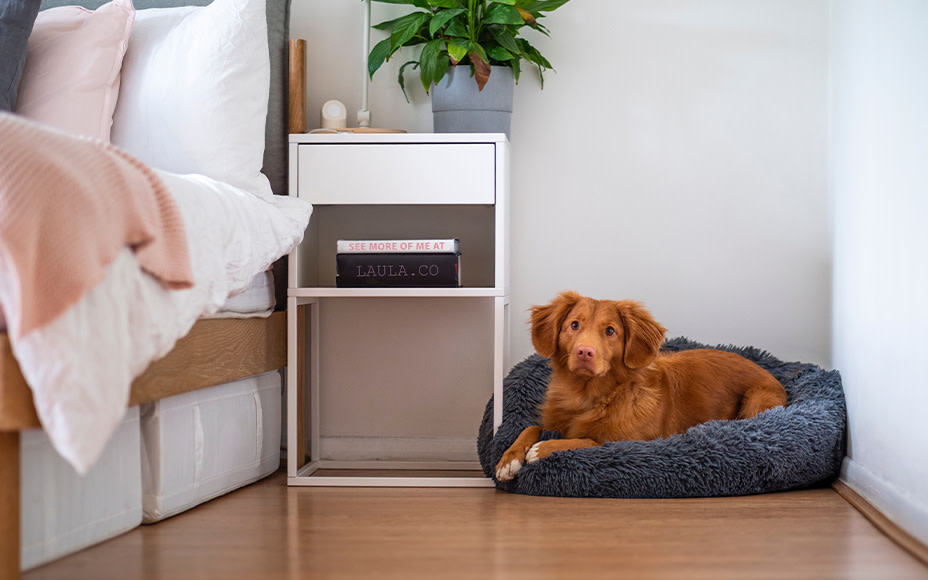
[TRANSLATION ERROR] Auch, wenn du deinen Hund in sein Körbchen schickst, kann das Aufbauen eines Freigabesignals hilfreich sein.
Why establish a release command?
This step is very important because it teaches your dog that he does not need to have an expectation (when will the next treat/chew come) while in the crate, and he also understands to respect the spatial assignments (crate) you have set and only enter new spaces with your permission.
For example, if you are transporting your dog in a car crate or your trunk, you certainly do not want him to jump directly out of the car into the parking lot as soon as you open the trunk or crate door. This can be quite dangerous - perhaps a car or cyclist is coming by, and there could be a serious accident. Here, you can also work with the release signal and only let your dog out of the transport crate when you have an overview of the situation and your dog is calm and relaxed.
Why not just close the crate?
But why leave the crate open if you can just close it? Discussing spatial assignments with the dog is an important step in dog training. Discussing means consistently sending the dog back into the crate whenever he leaves it without your permission. Why is this so important? Spaces are resources, and your dog learns that you allocate this type of resource, just like toys or food. If you simply close the door, your dog cannot learn that your instructions must be followed.
→Is your dog barking too much at home and when the doorbell rings, does he jump up and run barking towards it? Then working with a release command can also help here, making it clear to him that he needs to stay in his place - no matter what happens. Your dog will better understand that he is currently on pause and that everything else happening, like the postman or receiving visitors, is not his business and he can relax. He knows you will come to get him from his resting place and release him when it is his turn.
My dog doesn't like the crate and has a hard time calming down
You have tried crate training, but your dog still cannot calm down there, whines constantly, and may even rebel? Under no circumstances should you just put him in the crate and wait for him to calm down on his own. Simply locking the dog in a crate does not correspond to species-appropriate housing and causes a lot of stress for the dog!
Calm training and being relaxed at home is something many dogs need to learn. Patience and consistency are top priorities here. If your furry friend is struggling with this, it is **advisable to contact [→trainers](/magazin/hunde