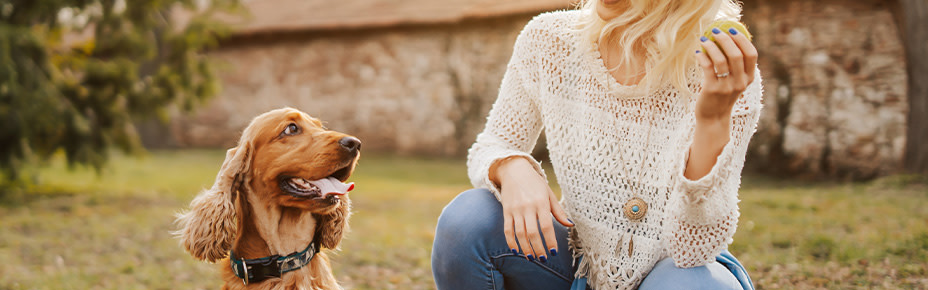
Sit, Place, Stay - what is important in dog training?
Maybe you've noticed that when it comes to training, many different opinions and approaches circulate. The reason for this is: Our furry friends are all different. And thus, the training approaches are also different. What works well for the neighbor's dog may not apply to you and your four-legged friend. Therefore: The training approach that suits you and your dog is the be-all and end-all!
Additionally, it's always good if your favorite learns the "dog ABC," meaning the "standard commands" like Sit, Place, Stay. Also, social behavior is important so that your furry friend doesn't become a bully but gets along well with other dogs and people. However, before you try forever, it's better to work directly with a dog trainer.
Motivation is Power
How do you best achieve your goals? Right. When you are motivated. The key to success is to show your furry friend that it is worthwhile to work with you. You achieve this best by motivating them.
Motivations can look different. Some dogs have a strong "will to please," they simply want to please their owner and do everything right. Are all other candidates hopelessly lost? No, don't worry. Other dogs can be particularly well motivated by play, food, petting, or simply a verbal praise. If you find out what motivates your dog, training will be easier.
Beliebteste Snacks für deinen Vierbeiner
Patience, Strong Nerves, and Consistency
But no matter how tasty your treats or how great your petting is - your four-legged friend will definitely challenge you. Many dogs like to test their limits. Jumping on the bed occasionally, pulling on the leash, or gnawing on the carpet, all of this (unfortunately) belongs to dog training. So, it’s time to: take a deep breath, be patient, keep your nerves strong, and always stay consistent!
When should you start dog training?
When a dog moves in with you, everything is exciting and new. Ideally, you would just want to play and cuddle all day. Surely, your furry friend also has a lot of silly ideas in their head, which you tend to overlook. After all, everything is still new, and the dog should first settle in.
Unfortunately, this is where the first mistake begins. It is important that your new roommate is taught the house rules from day one. If the dog is not allowed in the kitchen, on the sofa, or in bed, you must communicate that clearly. You are basically their mentor and show them which behavior is desired and which is not. The same applies outside in the park, on the street, in the garden, as well as in interactions with people and other dogs. Dog training starts right from day one.
Can a one-year-old dog still be trained?
The earlier you start training, the better. However, this does not mean that all older dogs are hopelessly lost. A one-year-old dog is currently in the middle of the →puberty. Here, the marbles in their head are quite mixed up. Therefore, it is all the more important to create structure. Older dogs may have stubborn habits. But even these can be changed with a lot of patience and consistent training. In this regard, working with an experienced trainer is very helpful.
Don't forget the right nutrition!
Dog training is more than just commands, rules, and social behavior. For your four-legged friend to feel good all around, you should pay attention to a healthy diet. This means that not only does your furry friend need to learn something, but you do too! If you are not very familiar with this yet, feel free to browse a bit in our →nutrition guide or let us →advise you for free.