Why should you even trim your dog's nails?
For some dogs, their nails wear down on their own. For example, if your four-legged friend walks a lot in the city on hard sidewalks or concrete, the nails are automatically ground down. Nevertheless, for many dogs, owners need to help by trimming the nails so they don't get too long.
Reasons for increased nail growth could be that your dog walks mostly on soft surfaces like forest paths or moves less, perhaps because he is sick or already old. A particularly rich diet can also promote nail growth.
What's best: nail scissors, clippers, or grinders?
With the right tool and a little practice, trimming your dog's nails is actually a pretty simple and quick task. Just like →brushing their teeth, it's part of caring for a dog and should be practiced early on. But which tool is the right one? Pet stores offer a wide range of pliers, scissors, and trimmers. Let's take a closer look at these:
Nail scissors or nail pliers: There are special scissors and pliers that have a rounded cutting surface and are specially designed for cutting dog nails and are suitable for this purpose. The tool should definitely be matched to the size of your dog's paw and held at the correct angle to the nail to avoid splintering. You should never use regular nail scissors or clippers!
Nail trimmers or nail grinders: Others prefer electronic trimmers or grinders for shortening dog nails. These are small electronic devices that gently grind down the nails. They are especially suitable for small animals or very anxious dogs.
Nail file: For the final touch, a manual nail file is suitable. Especially if you use nail scissors or pliers, you can use a file at the end to round everything off and gently remove any horn residue.


In addition to a claw scissors, claw grinders are also well suited for trimming your dog's nails.
How to properly trim your dog's nails
To keep your dog from hiding under the sofa at the sight of the nail trimming tool, you should slowly get him used to having his nails trimmed. If your dog has trouble with physical closeness or being touched and is →very anxious, you should put on a well-fitting muzzle for safety. Because: sooner or later, the nails will need to be trimmed.
1. Grab your dog and your tools.
These include: nail scissors, grinder or other tools, a coat scissors, and possibly a flashlight. If your dog reacts to physical closeness by snapping, it's better to put a muzzle on (safety first!) and have your vet show you how to trim nails!
2. Enclose the paw with your hand and hold it firmly.
Of course, you shouldn't hurt your dog. But it's important that you hold the paw firmly in your hand, in case he tries to pull it away suddenly. If your dog already struggles with this, practice it. Praise him a lot with treats or a "Good job!"
3. First, use the coat scissors to remove excess fur from the paw pads.
If your dog already has trouble with this, practice and reward him a lot!
4. Cut/file the nails without injuring the nerves.
Now cut the nails up to 2 mm before the quick (the pink tissue inside the nail). With light-colored nails you can easily see how far you can cut. Where you see some pink inside the nail, the nerves begin and injuring them would be extremely painful for your dog. So only cut up to a maximum of 2 mm before the pink tissue of the nail. With black nails you can use a flashlight (a phone flashlight is enough) to illuminate the nail and use a pen to mark where the nerves end. Or you can work your way forward bit by bit, until you see a small dark dot in the middle of the nail. This is a sign that the nerves start behind it.
Important: By holding the tool at a right angle to the nail, you avoid splintering the nail!
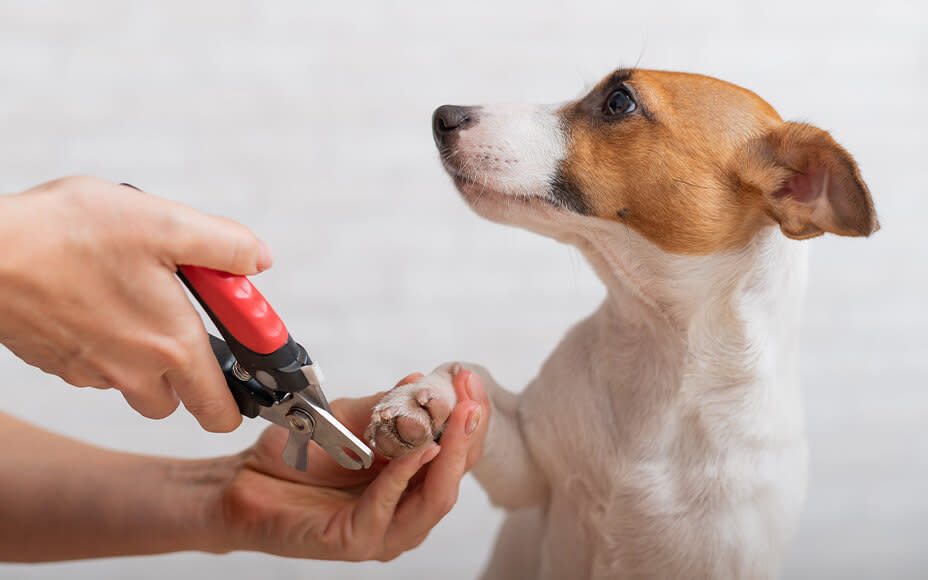
So your dog can relax while having its claws trimmed, it's worth practicing early on from puppyhood. This way, your dog learns that you can touch him anywhere and hold his paws for longer.
5. Positive ending: Don't forget the reward!
If your dog handled everything well and all the nails are trimmed, it's time for a tasty treat! That way you end the nail trimming session on a positive note. Many dogs don't like nail trimming and →get stressed quickly. Especially in the beginning, you should use lots of praise and even more treats to convince them. If there are two of you present, one person can distract the dog for example by letting him lick a →liver sausage tube while the other person quickly trims the nails.
Delicious Rewards for Brave Dogs
How do I know if my dog's nails are too long?
If your dog walks through the apartment and you can clearly hear the nails clicking on the floor it's time to trim the nails a bit. Alternatively, you can place your dog's paws in front of you and then look from the side, to see if the dog's nails touch the floor. Ideally, the nails should hover just above the floor when standing (rule of thumb: a sheet of paper should fit between the floor and the dog's nail).
If you're unsure, you can also have your dog's nails trimmed by a vet, for example during your →annual routine check-up. Let them know in advance at your appointment so the vet can schedule enough time.