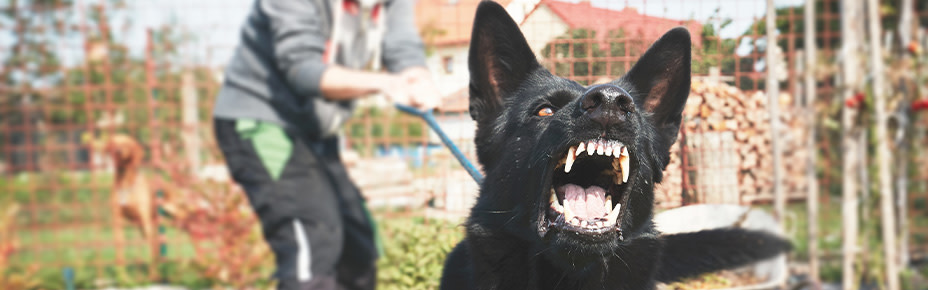
Help, my dog is aggressive!
Just a moment ago the dog was cuddling so nicely with the child and then suddenly – snap – he snaps or even tries to bite? At home your four-legged friend is a real angel, but outside he barks at other dogs or people and jumps and pulls on the leash? When it comes to food your dog has no sense of humor and growls at you baring his teeth?
When your own dog shows aggressive behavior, many dog owners are not only surprised but also desperate. But what many don't know: A dog very rarely shows suddenly and without warning aggressive behavior. Unlike us humans, dogs communicate a lot through body language. When a dog shows aggressive behavior like snapping, there are often some important signals beforehand. Also, the reasons for displaying aggressive behaviors can be very different. For this reason, it's very important to deal with your dog's →body language and that of dogs in general in depth.

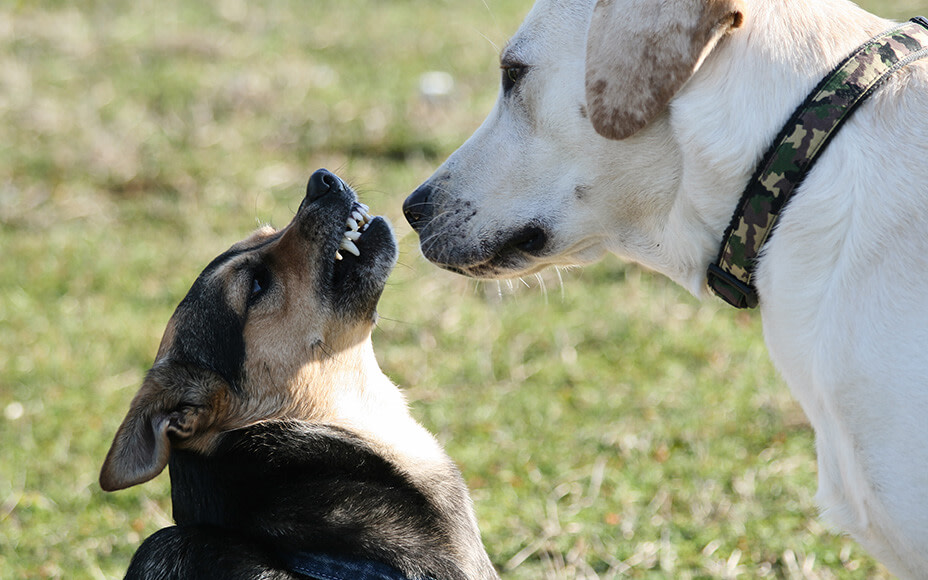
Some dog breeds are considered more aggressive than others – but they can all bite!
Training aggressive behavior in dogs
First, we want to emphasize that aggressive behavior in dogs is something to be taken seriously. Before the situation gets worse or undesirable behaviors become ingrained in your dog, you should contact qualified dog trainers. Searching the internet for →tips or completing an →online dog training course can be helpful. However, for a long-term change in behavior in your dog, it often requires individual training.
Dog trainers come to your home, listen closely to your story, and observe how you and your dog interact. They explain the cause of your dog's aggressive behavior and discuss with you possible training approaches to work on it together. Every dog-human team is unique, and so are the training paths.
Growling, barking, snapping – is that normal?
Did you know that aggressive behavior is completely normal and is part of the dog's communication repertoire? It makes sense, because dogs are living beings and feel more than just joy over food or the next cuddle session. Frustration, insecurity, or fear are also part of it. Some →dog breeds are also born with it, having a higher protective or guarding instinct and therefore show aggressive behaviors more often.
Of course, your dog should not and must not just nip at everyone's hands during your walks or get into fights with every dog in the park. Still, it's important to understand that aggressive behavior in dogs is part of the norm within certain limits and is not always equal to a malicious intent to injure. That's why it's important to first find out the cause of your dog's aggressive behavior find out.
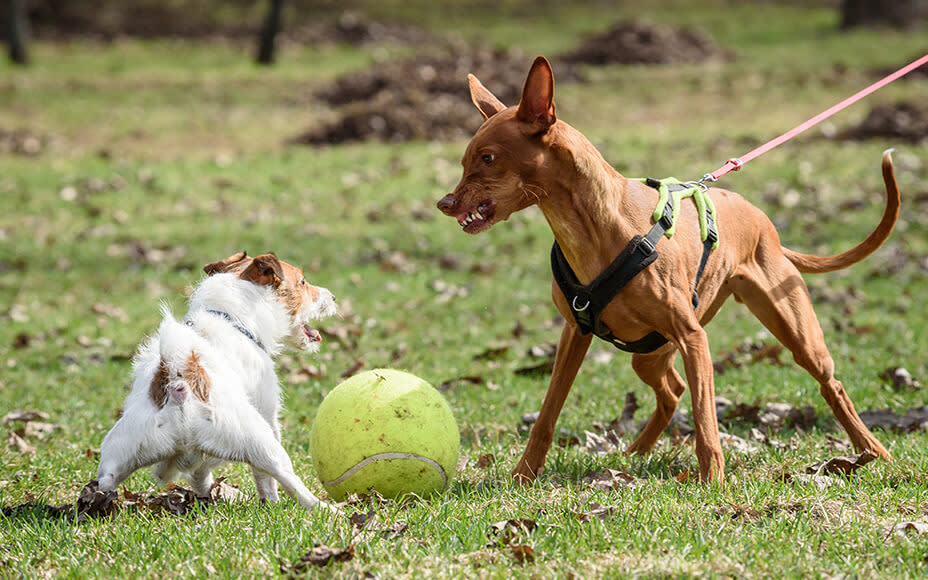
Under certain circumstances, aggressive behavior in dogs is normal. It is just as much a part of communication as wagging their tail happily.
What is the cause of your dog's aggressive behavior?
Unlike us humans, dogs can't use words to say what's bothering them. Still, in most cases, they show us quite clearly – through their body language! For example, a dog who doesn't like to be touched might first show this by turning his head away, yawning, blinking rapidly or even by getting up and walking away. If we keep pushing and (unknowingly) force the dog into close contact, he might eventually snap to defend his boundaries even more clearly.
Besides crossing the so-called individual tolerance other possible causes for aggressive behavior in dogs include:
Insecurity
bad experiences/past
guarding and protective instinct
prey drive
frustration
status
pain
There can also be several causes at once. For example, a dog with a low frustration tolerance and insecure around other dogs may start barking and lunging on the leash more quickly than a dog who walks confidently and relaxed through the streets. In addition, some of these causes can influence each other, for example, if a dog had a painful bicycle accident and now is afraid of all cyclists and barks at them loudly.
A little tip: Have your dog checked by a vet. Maybe there's a disease causing your pet pain behind the aggression? A hormonal imbalance or other health issues can encourage aggressive behavior. If your dog struggles with vet visits, you can reward him generously with tasty treats during and after the treatment!
Delicious Rewards for Brave Dogs
Recognizing and correctly interpreting a dog's body signals
When we talk about aggressive behavior, we usually think of biting, barking, and growling. As already mentioned, however, these behaviors are often preceded by numerous other body signals – the so-called calming signals, displacement behaviors, and stress signals – first. All these body signals, from mild calming signals to repeated biting with intent to injure, are divided into so-called escalation levels. These are comparable to a traffic light:
The escalation levels
Green zone – everything is fine, the dog is politely showing that something is bothering him: Behaviors like yawning, shaking, turning the head away, or licking the nose are in the green zone.
Yellow zone – be alert, the dog is showing more clearly that something is wrong: Behaviors like barking, raised hackles, or biting the leash are still in the yellow zone.
Red zone – pull the emergency brake, your dog sees no other way out: Behaviors like snapping at the air, inhibited biting up to uninhibited biting are in the red zone.
Depending on his individual experiences each dog will show certain calming signals and behaviors more or less often or never at all.
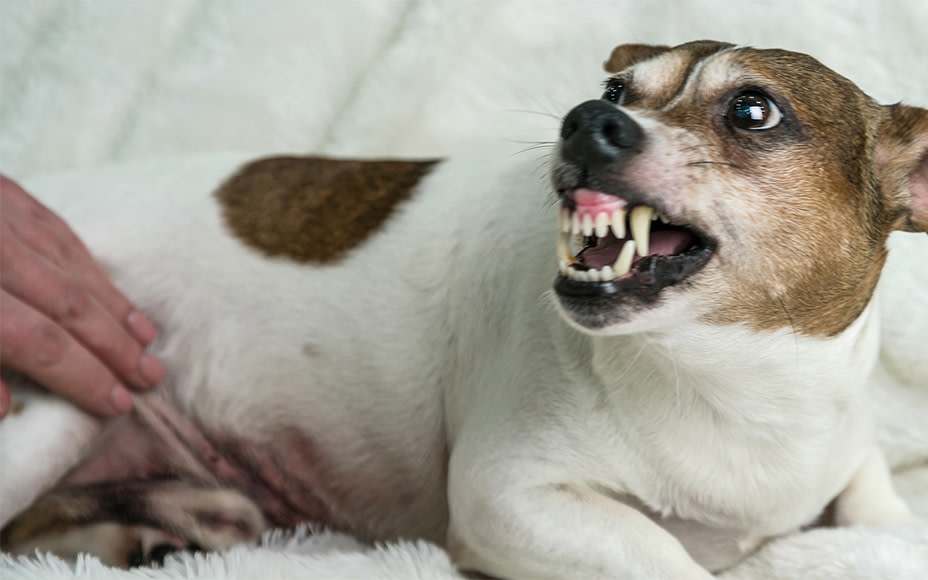
Above all, the boundaries of smaller dogs are often not respected. Growling and barking are usually dismissed as cute behavior, but can also end with a painful bite.
An example: The dog's goal = keep people at a distance
A dog you →adopted second hand may, due to many bad experiences, react aggressively right away to other people and bite. Maybe in the past his calming signals were ignored and he learned that only biting gets results and keeps people away.
A dog who comes to you as a puppy and learns from the start that his individual tolerance is respected and that even the smallest calming signals are taken into account will have learned that this behavior is successful (people back off) and therefore will not bite right away.
Stopping aggressive behavior in dogs through correction?
A correction in dog training can look very different. Even a "Nooo" or a short "Hey!" is a verbal correction. Under no circumstances should you try to correct your dog's aggressive behavior on your own. That can only make things worse. Actions like pinning the dog to the ground, holding his muzzle shut, or just yanking hard on the leash are not suitable tools to help your dog in the long run.
A correction can help your dog understand that he just made a mistake and something is not wanted. At the same time, you must also show him which behavior is desired instead and encourage or reinforce. It's also important to work on the cause of aggression and ideally help your dog, learn alternative behaviors and become more confident and relaxed in life. A correction should never be about simply suppressing the aggressive behavior and "putting the dog down."
Here too, a trainer can and should help you. Make sure you find a professional you feel comfortable with and enjoy working with and whose training methods you support.
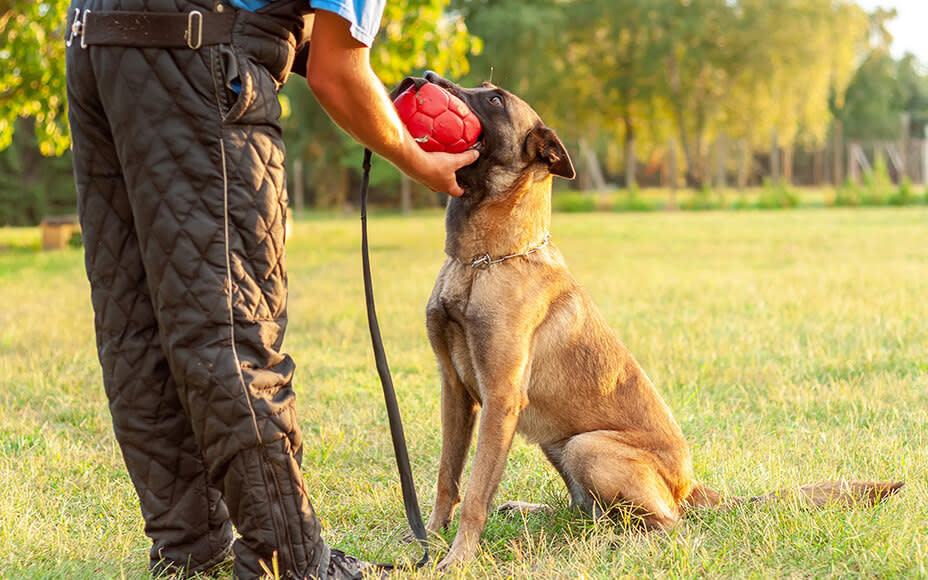
If you engage with your dog's breed and know how to work with it, you will become a strong team!
Is there dog aggression training?
As you can see, the topic of aggressive behavior in dogs is quite extensive and complex. A simple correction is usually not enough. To truly change your dog's behavior for the long term and become a team together, the →collaboration with experienced dog trainers is almost essential.
Since dogs, unlike us, can't say with words what's bothering them and we can't explain to them with words that they should just calmly walk past other dogs, a special dog aggression training can be helpful. In most cases, the key to changing the dog's behavior lies with the owners. That means, with the right trainer by your side, you can learn a lot about yourself and your dog, more about dog body language and give your dog the security and leadership he needs.