Reproductive organs
Let's start with the obvious: the sex organs. Female cats have a uterus and ovaries, while male cats have testicles. Nipples on the other hand are found in both female and male cats. Unlike female cats, male cats cannot produce milk with their nipples and therefore cannot nurse kittens.

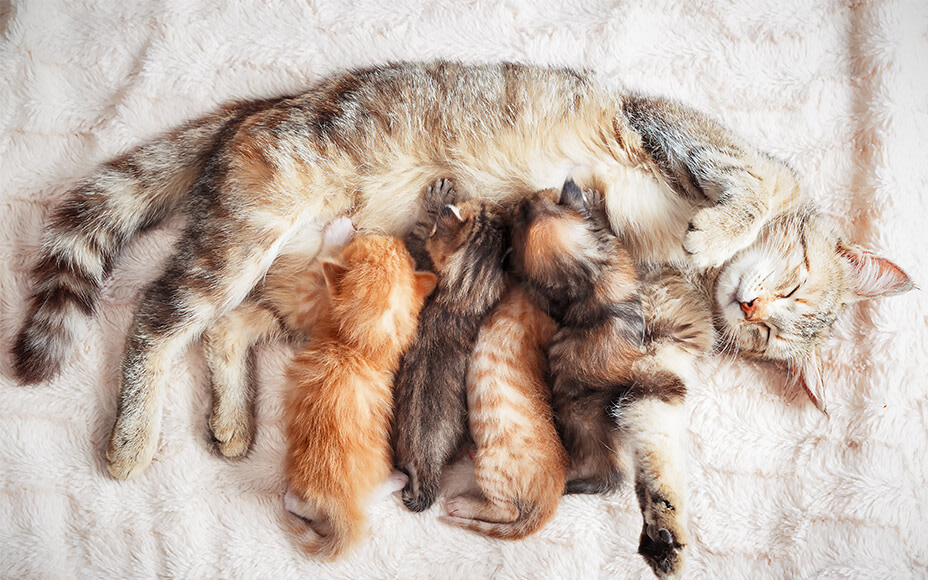
Kittens suckle at their mother's teats and knead her belly. This "milk tread" is meant to stimulate milk flow and has a calming effect on cats.
Size and weight
Male cats are generally →larger and heavier than female cats. However, this is not a hard rule. Depending on the breed and individual genetic factors, there are many exceptions.
Coat pattern
As with many other animals, the coat pattern can also vary between female and male cats. For some pedigree cats, there are breed-specific differences in coat color or pattern between the sexes. However, this is not universal.
Regardless of whether male or female – →proper coat care is needed by both velvet paws!

Cats are social creatures and should ideally always be kept in pairs and not left alone for more than one night.
Body structure
The body structure can vary slightly. Male cats sometimes have a stronger head and a more muscular neck. Female cats usually appear more delicate.
However, the differences between male and female cats are not always clear andmany things again depend on individual factors.
Territorial behavior
Male cats, especially if they are not neutered, tend to show territorial behavior. This is evident by marking their territory, i.e. urinating in various places to deter potential rivals. By the way, this can also happen indoors! Female cats can also be territorial, but their behavior is often less pronounced. Unneutered female cats also become →regularly in heat.
Have your cat neutered:
The right age & more information
Susceptibility to disease
Certain →health conditions are attributed to both male and female cats. For example, male cats are said to be more susceptible to →urinary tract diseases, while female cats are more prone to breast cancer.
Regardless of gender, a →healthy and nutrient-rich diet forms the basis for a long and happy cat life. Here at Pets Deli we focus on the highest quality standards in every one of our products, so your cat can stay healthy through all 7 cat lives.
Healthy at Every Age: Our Cat Food for 7 Cat Lives
Social behavior
Female cats are said to be more social and tend to form a closer bond with their owners. Male cats are possibly more independent and do not always seek closeness right away. Note! This trait can also vary depending on individual character.
Are you looking for a cuddly cat? Take a look at →our list of 7 cat breeds that love to cuddle.
Play behavior
Male cats often show more intense play behavior. They are said to be more often interested in interactive games. Female cats also love to play, but their play can sometimes be more subtle and less rough.
Whether your four-legged friend is playful or not is often simply a matter of disposition. There are also male and female cats that are just →more laid-back and enjoy relaxing on the sofa.

Together you're less alone: If you get two kittens, they can play and cuddle together.
Life expectancy
In some cases, gender can also influence life expectancy. A healthy lifestyle with a nutrient-rich, high-quality diet, plenty of rest and sufficient activity supports your pet's health best of all.