
Vegetarian diet for dogs – species-appropriate or unhealthy?
Since the shift in dietary trends over the last 10 years, more and more people are giving up meat – and even cutting out animal products like milk, honey, and leather from their daily lives. Animal welfare and protecting our climate are topics that lead many dog owners to wonder if it's possible to feed their dog a vegetarian diet. Rarely does a feeding topic cause such a huge divide – but what is actually right?
In principle, a dog can be fed a vegetarian diet. The meal plan must contain a certain amount of proteins, carbohydrates, fats, fiber, minerals, and vitamins. If you've ever read a non-fiction book or paid attention in class, you know that plant-based foods in particular are packed with nutrients. But is that enough to meet the needs of dogs?
Natural eating behavior of dogs: In the beginning was the wolf – or was it?
If you want to take a look at the natural eating behavior of dogs, you have to go way back in time. So far back that you wouldn't find any of our modern four-legged friends there, but – that's right – the wolf. If you look at the wolf and its prey, it quickly becomes clear that mainly meat along with bones, cartilage, and organs was and still is eaten. But the prey's stomach was also on the menu and this was eaten including fruits, vegetables, and herbs. The idea that the ancestors of dogs ate only meat and nothing but meat (spoiler, →Myth!) around the clock is therefore not true at all, which is why wolves and dogs are considered meat-eating omnivores, also known as (carni-omnivores).
As already mentioned, the origin of our dogs goes way back. More than 20,000 years ago, the wolves of that time began to approach humans, lived with them, and ate with them. The result: The wild dogs adapted to human food. In the course of the domestication of wolves, not only did the appearance of our dogs change, but also the gastrointestinal tract adapted to living with humans. Today, our four-legged friends have different digestive enzymes (e.g. amylase), which allow them to easily digest and utilize starchy components as part of their food.


Tasty, vegetables! Many dogs also enjoy snacking on meat-free food voluntarily. No wonder, since their digestive system is designed for it, among other things.
Does my dog get all the nutrients it needs with a vegetarian diet?
With a vegetarian diet, it is definitely possible for your dog to get all the nutrients it needs. As you just learned, the bodies of our modern dogs are adapted to metabolizing vegetables, fruit and other vegetarian ingredients. Unlike a →vegan diet for dogs, a vegetarian diet does not exclude animal protein, as animal products can still be fed. The nutrition pyramid for your dog, ensuring all nutrients are covered, can be roughly divided as follows. Note that the amounts are not the same for every dog and feeding varies depending on age. →Senior dogs and also →puppies need specially adapted food.
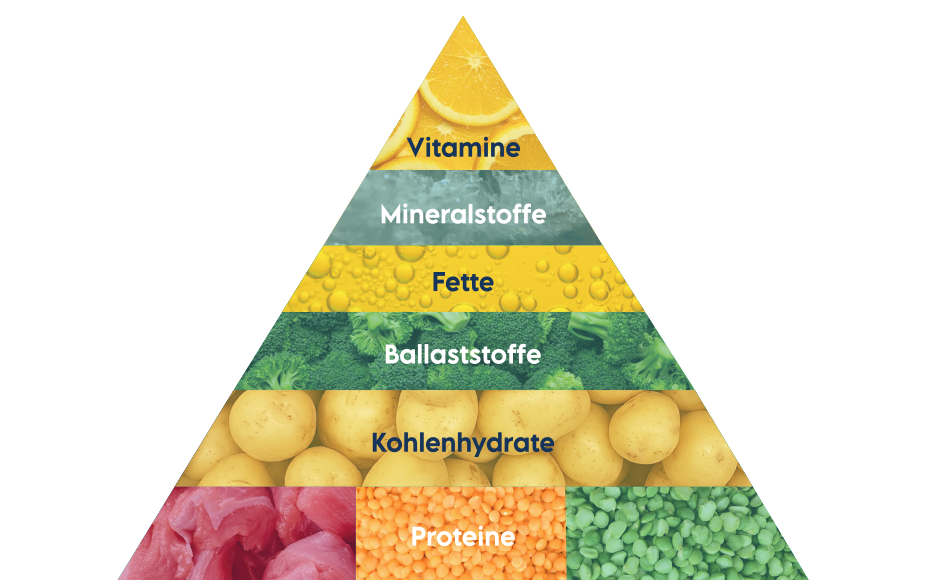
Just like for us humans, there are also recommendations for the composition of meals for dogs. As you can see: animal proteins can easily be replaced by plant-based ones.
As you can see, a large part of the pyramid is already vegetarian by default. So there isn't as much to "replace" as you might have thought at first. What matters for your dog is that it gets the nutrients it needs for an active daily life. Here you can see where your dog can get these nutrients from a balanced vegetarian diet:
Proteins / protein: Legumes such as lentils, chickpeas, beans, hulled hemp seeds, egg, cottage cheese
Carbohydrates: →sweet potatoes, →potatoes, →rice or pseudo-grains like quinoa, amaranth, millet, or buckwheat, pasta
essential amino acids: legumes, →nuts, seeds, green vegetables like →broccoli
essential fatty acids: algae oil, linseed oil, hemp oil, olive oil, flaxseed, pumpkin seeds
Vitamins, minerals, and trace elements: types of vegetables and fruits such as →broccoli, →pumpkin, →celery, →sweet potato, →spinach, →mushrooms, →cauliflower or →apple, →banana, →orange, →watermelon, →blueberries, →blackberries, →strawberries, →mangoes
Carbohydrates: →sweet potatoes, →potatoes, →rice or pseudo-grains like quinoa, →amaranth, millet, or buckwheat
Did you know that our dogs also leave a paw print? One kilo of beef uses about 15,500 liters of water before it ends up in your dog's bowl. Potatoes, on the other hand, use only 210 liters of water per kilogram and carrots 110 liters. With our GREEN food, we make a contribution to a better environment and climate protection. 100% climate neutral, super tasty and also available as →vegetarian and →vegan food.
Green, greener, Pets Deli GREEN – discover our vegetarian & vegan food now
Nutrient requirement challenge: How to successfully feed dogs a vegetarian diet
If you want to feed your dog a vegetarian diet, there are a few things you should pay attention to, so your dog gets all the nutrients it needs and doesn't end up with a deficiency or excess. If you're thinking: Great, then I'll just start cooking up a vegetarian menu for my furry friend myself, we have to slow you down. Even when feeding meat, it's not always the best solution to just serve any random food. A look at the ingredients is worthwhile, because →the quality of a food and a →species-appropriate diet are important for your dog's health. Whether you feed your dog →wet food, dry food, or BARF, it's the content that matters.

Health in the bowl – this includes high-quality components such as crunchy fruits and vegetables that provide nutrients and support the immune system.
Before switching→your dog's food to a vegetarian diet, consult your veterinarian, to rule out possible intolerances. Especially dogs with sensitive stomachs, who even react to →sensitive meat varieties, can benefit greatly from →a vegetarian or vegan dog diet. Especially if you want to cook for your dog yourself, it's important to seek advice from nutrition experts. Just like with BARF, where you either buy pre-made menus or create and weigh the portions yourself, you need a trained eye and possibly added minerals, so your dog is optimally supplied. But isn't that artificial? On the contrary – with our →Mineral Mix, for example, we supplement BARF so that no organs, bones, or cartilage are fed. The ingredients are eggshell, green-lipped mussel, and yeast of purely natural origin.
You'll love to try BARF!
What does science say about vegetarian dog nutrition?
Due to the broad interest in the topic, studies on vegetarian and vegan diets in dogs of various breeds have also been conducted in the past. In one sample of 2,500 dogs, it was found that among the meat-eating dogs, more than half required medication during this period, while among vegetarian or vegan dogs, the proportion was only about a third. The general state of health can be considered on average better for four-legged friends on this diet – provided it is strictly nutritionally correct.
Studies by Murray and colleagues on the digestion of plant-based components as early as 1999 showed similarly positive results, in which dogs are perfectly able to digest and utilize starchy food.
Our compromise: With Veggie Wednesday, a vegetarian or vegan day once a week
You don't want to go all in, but you're still curious? Why not try a meat-free day once a week – you and your four-legged friend can do this experiment together. This not only strengthens →your bond, but also raises awareness for topics like healthy and conscious nutrition or climate protection. Plus, you'll see that most dogs can find vegetarian food irresistibly tasty too. Good taste doesn't always need meat – and no four-legged friend can resist a fresh menu!
Are you interested in how we and our office dogs are reducing the ecological footprints and paw prints or want tips for a climate-friendly life with your furry friend?