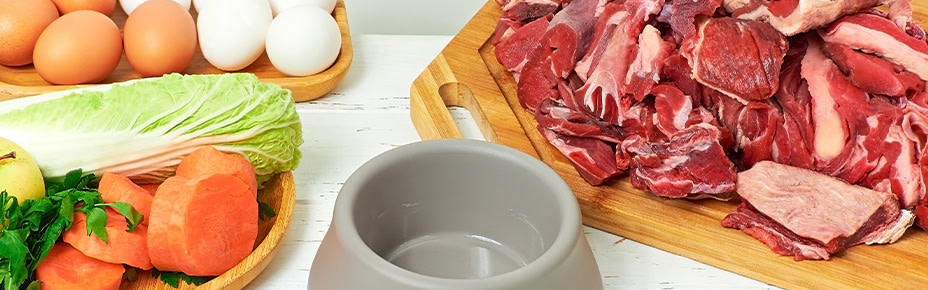
Can you feed a puppy raw?
With →BARFing, raw ingredients such as fresh meat, vegetables, fruits, healthy herbs, and oils are fed to your dog. This requires a precise dosage of the ingredients as well as the addition of minerals to ensure that your four-legged friend is optimally supplied with all essential nutrients. Often, dog owners only become aware of the BARF concept later, when the dog is already a bit older. However, opinions vary greatly on whether one can also BARF their puppy.
We at Pets Deli recommend: If your puppy is already familiar with raw feeding from its →breeder, you can continue BARFing from day one with you. In this case, your puppy's body has already adapted to BARFing right after weaning from mother’s milk, and the digestive system has already adjusted to this feeding method. However, if your puppy has previously been fed dry or wet food, we recommend switching to BARF only starting from the 6th month of life to avoid overwhelming the digestive system.

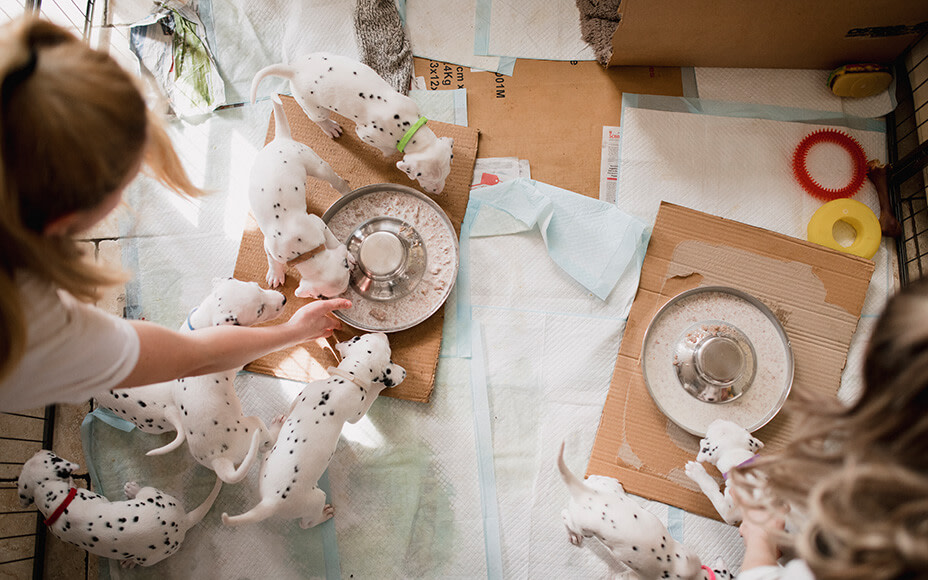
[TRANSLATION ERROR] Manche Züchter*innen geben den Welpen zusätzlich zum Welpenbrei schon etwas rohes Fleisch und gewöhnen sie so langsam ans BARFen.
Right after birth....
... BARFing is not yet a topic for the puppies, as in →the first 3-4 weeks of life the little ones receive only mother’s milk.
From the 5th week, the time begins when the puppies start to show more interest in their environment and especially want to see what mom has in her bowl. As the interest in the mother’s food grows and the willingness to nurse decreases, breeders start with the first solid meals for the puppies. However, this is not real BARF, but rather an almost liquid meat-free porridge.
If breeders want to get the puppies used to BARFing directly, they can also start feeding some lean meat at this time. Ground beef or →turkey meat are particularly suitable. As soon as the milk teeth of the puppies are fully developed, breeders can start giving easily chewable, meaty bones to eat, such as chicken necks.
When can I start BARFing my puppy?
If your puppy moves in with you and has already been BARFed at its breeder, you can continue this feeding method directly. In this case, your puppy is already accustomed to raw, solid food and its digestive system is adjusted to it. Many breeders who BARF their dogs are happy to advise future owners of their puppies and help them get started with BARFing.
If your puppy has previously been fed with →dry food or →wet food, we recommend that you wait until the 6th month of life before switching to BARF. The digestive tract of puppies is still very sensitive at this time and can quickly become overwhelmed by a switch to raw feeding. If you still want to switch to BARF directly, make sure to consult trained nutrition or BARF advisors**.

[TRANSLATION ERROR] Manche Züchter*innen BARFen ihre Welpen direkt von Anfang an. Möchtest du später aufs BARFen umstellen, empfehlen wir, bis zum 6. Lebensmonat zu warten.
How to properly BARF your puppy
If you want to start BARFing your puppy, it’s best to have a trained BARF advisor create a personalized feeding plan for your four-legged friend. Unlike with a complete feed, when BARFing, you put together all the food components yourself and are responsible for ensuring that your puppy receives all the necessary nutrients in the right amounts.
Here are some things to consider when BARFing puppies:
- Puppies require a larger →amount of food than adult dogs and should receive about 4-8% of their own body weight in fresh meat per day. Initially, you should divide the total ration into →4 meals, later your puppy will only have 3 or 2 meals a day.
- Due to their milk teeth, puppies usually cannot chew large pieces of meat yet. Therefore, you should start with ground meat.
- Puppies have an increased calcium requirement since their bones are still growing. This can be covered either through a mineral supplement or by feeding udder meat, cartilage, and bones. Here too, the little ones have difficulty chewing cartilage and bones due to their milk teeth, so you should initially rely on (ground) chicken, turkey, and duck necks.
- Adding high-quality minerals is extremely important for puppies, as they support the development of skeleton, tendons, ligaments, and joints during the growth phase.
- In addition to raw meat, the right amount of fish is important in BARF feeding. If your dog does not like to eat raw fish, you can also use high-quality fish oil. Our →salmon oil is rich in valuable omega-3 and -6 fatty acids and enhances your furry friend's food.
- The right amount of fruits and vegetables is also important when BARFing. They provide your puppy with necessary vitamins, fiber, and trace elements.
As you can see, there is a lot to consider when BARFing. Simply mixing various ingredients together for your dog without proper knowledge can lead to malnutrition. For beginners, feeding ready-made BARF menus can also be helpful. These already contain all the important components for your puppy.
Are you interested in switching your adult dog to BARF, but find all the calculations and weighing too complicated? Then try our [→BARF Fresh Menus for Dogs](/collections/fur-hunde-barf-frische-menus)! Enhanced with our mineral mix and a high-quality oil, we make BARFing easier for you** and provide your dog with absolute nutrient freshness in the bowl!
You'll love to try BARF!
Can I give my puppy the same food as my other dog(s)?
Whether you want to BARF your puppy or give it wet or dry food - young dogs need →special junior food, as they have special needs. Because they are still growing and their bones, organs, joints, and muscles are still developing, they need more proteins and minerals than adult dogs.
If you already have a dog at home and want to give both the same food, you will have to wait until your puppy is 12 months old. After one year, your little four-legged friend can then be switched to food for adult dogs and can enjoy meals together with your first dog!
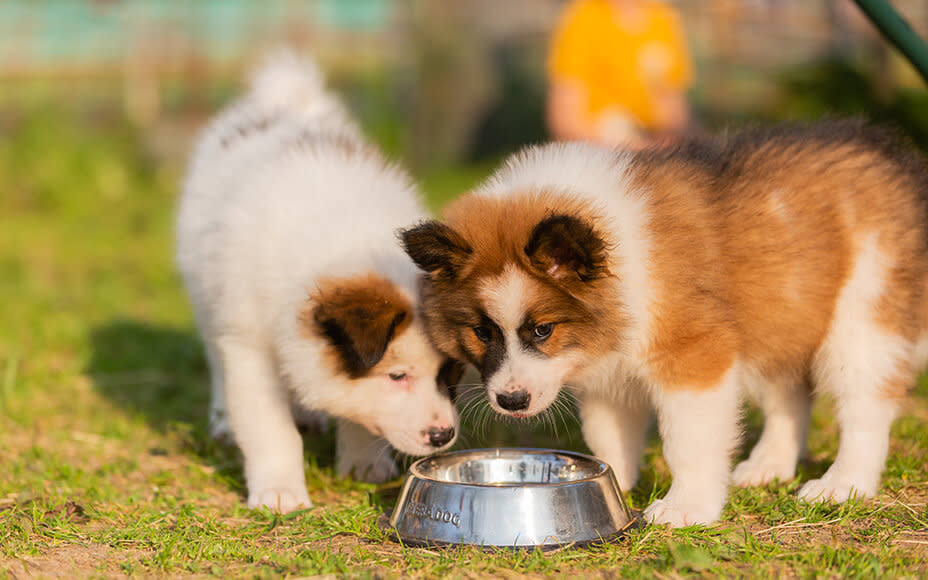
[TRANSLATION ERROR] Welpen haben bis zum 12. Lebensmonat besondere Bedürfnisse und benötigen deswegen ein spezielles Juniorfutter. Später kannst du deinem Hund das gleiche Futter geben.
Switching from BARF to wet or dry food - is that possible?
But what if the opposite occurs and your puppy was BARFed at its breeder, but you prefer to give a complete feed? That is, of course, completely legitimate, and with a high-quality wet or dry food, you can feed your puppy →healthy and species-appropriate. Ideally, you should discuss this with the breeder in advance and together consider how to make the →transition to the new puppy food gentle. This way, the breeder might already mix the junior food you selected with the BARF a few days before the puppy leaves. Or you can continue BARFing your puppy for a few days and gradually switch to the new food.
With our Pets Deli Junior Food, your little furry friend is provided with everything it needs for an adventurous day. A special food for puppies is designed until the 12th month of life with lots of meat, healthy fruits and vegetables, rich oils, and fresh herbs, tailored to the needs of a puppy and for healthy growth.