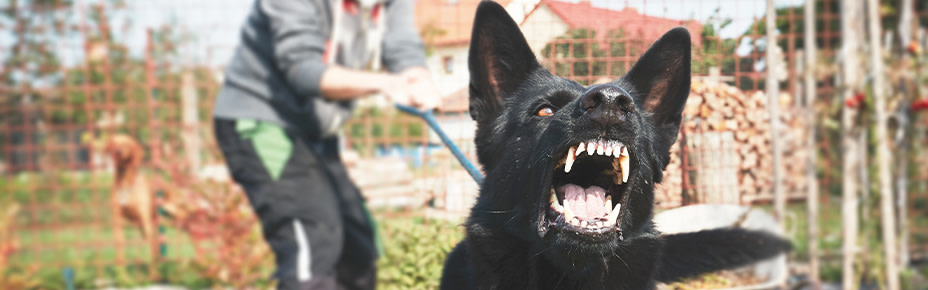
Help, my dog is aggressive!
Just a moment ago, the dog was cuddling beautifully with the child, and all of a sudden - bam - he snaps or even wants to bite? At home, your four-legged friend is a true angel, but outside he barks at other dogs or people and jumps and pulls on the leash? When it comes to food, your four-legged friend doesn't joke around and growls at you with bared teeth?
When a dog shows aggressive behavior, many dog owners experience not only surprise but also great despair. However, what many do not know is: A dog rarely shows aggressive behavior *suddenly* and *without warning*. Unlike humans, dogs communicate a lot through body language. When a dog displays aggressive behavior like snapping, it is often preceded by some important signals. The reasons for showing aggressive behaviors can also be very different**. For this reason, it is very important to engage with the →body language of your own four-legged friend and that of dogs in general.

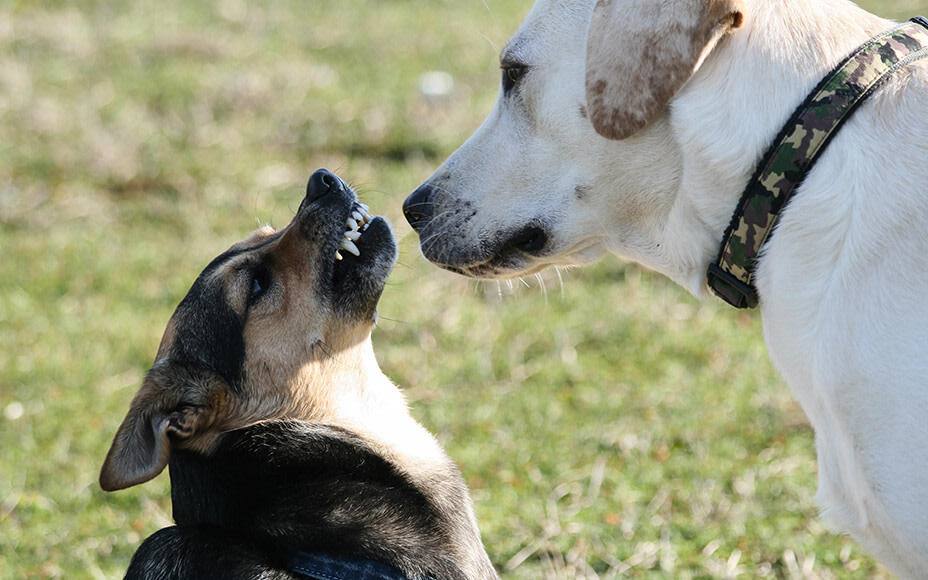
[TRANSLATION ERROR] Manche Hunderassen gelten als aggressiver als andere - zubeißen können sie aber alle!
Training aggressive behavior in dogs
First of all, we want to emphasize that aggressive behavior in dogs is something serious. Before the situation worsens or undesirable behaviors become entrenched in your dog, you should contact trained dog trainers. Researching →tips online or completing an →online dog training can be helpful. However, a long-term behavioral change in dogs often requires individual training.
Dog trainers come to your home, listen carefully to your story, and observe how you and your four-legged friend interact with each other. They explain the cause of your dog's aggressive behavior and discuss with you possible training approaches to work on it together. Every dog-human team is unique, and training paths are just as individual.
Growling, barking, snapping - is that normal?
Did you know that aggressive behavior is something completely normal and is part of a dog's communication repertoire? It makes sense, as dogs are living beings and feel more than just joy over food or the next cuddle session. Frustration, insecurity, or fear are also part of it. Some →dog breeds are also predisposed to have a higher protective or guarding instinct and therefore show aggressive traits more frequently.
Of course, your dog should not just be allowed to nip at every person during your walks or wrestle with every dog in the park. Nonetheless, it is important to understand that aggressive behavior in dogs is part of a certain framework and is not always equated with malicious intent to injure. For this reason, it is important to first find out the cause of your dog's aggressive behavior.
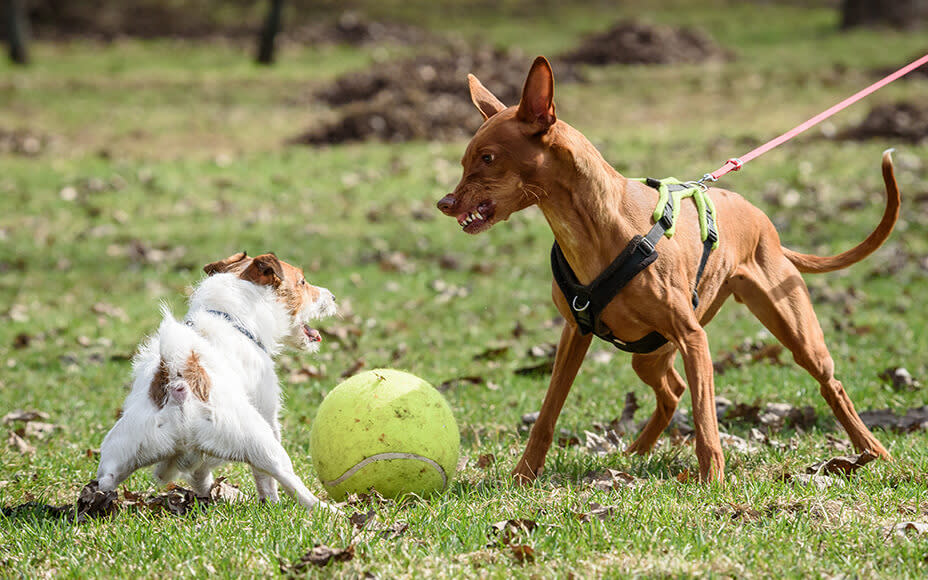
[TRANSLATION ERROR] Unter gewissen Umständen sind aggressive Verhaltensweisen bei Hunden normal. Sie gehören zur Kommunikation genauso dazu wie freudig mit dem Schwänzchen wedeln.
What is the cause of your dog's aggressive behavior?
Unlike humans, dogs cannot verbally express what bothers them. However, they often show it quite clearly - namely through body language! A dog that does not like to be touched may initially turn its head away, yawn, blink quickly, or even get up and walk away to make this clear. If we keep pushing and unknowingly force the dog into physical closeness, it may eventually snap to defend its boundaries more clearly.
In addition to exceeding the so-called individual tolerance, possible further causes for showing aggressive behavior in dogs include:
- Insecurity
- →Fear
- Bad experiences/past
- Guarding and protective instinct
- Hunting instinct
- Frustration
- Status
- →Illness
- Pain
There can also be multiple causes at the same time. For example, a dog with low frustration tolerance and insecurity around other dogs may react more aggressively on the leash than a dog that walks confidently and relaxed through the streets. Additionally, some of these causes can influence each other, for instance, when a dog has had a painful bicycle accident and now fears all cyclists and barks at them loudly.
A little tip: Have your dog examined by a veterinarian as well. Perhaps an illness causing pain is behind the aggression? A hormonal imbalance or other health issues can also promote aggressive behavior. If your dog struggles with vet visits, you can reward him with tasty treats during and after the treatment!
Leckere Belohnungen für tapfere Hunde
Recognizing and correctly interpreting a dog's body signals
When we talk about aggressive behavior, we usually think of biting, barking, and growling. As mentioned earlier, however, these behaviors are often preceded by numerous other body signals - the so-called *calming signals, displacement behaviors, and stress signals. All these body signals, from light calming signals to multiple bites with the intent to injure, are classified into so-called escalation levels. These are comparable to a traffic light*:
The escalation levels
- Green area - everything is fine, the dog shows nicely that something bothers him: Behaviors like yawning, shaking, turning the head away, or licking over the snout are in the green area.
- Yellow area - be cautious, the dog shows more clearly that something is wrong: Behaviors like barking, raised hackles, or biting the leash are still in the yellow area.
- Red area - pull the emergency brake, your dog sees no other way out: Behaviors like snapping in the air, inhibited biting to unrestrained biting are in the red area.
Depending on their individual experiences, each dog will show certain calming signals and behaviors more or less frequently or not at all.
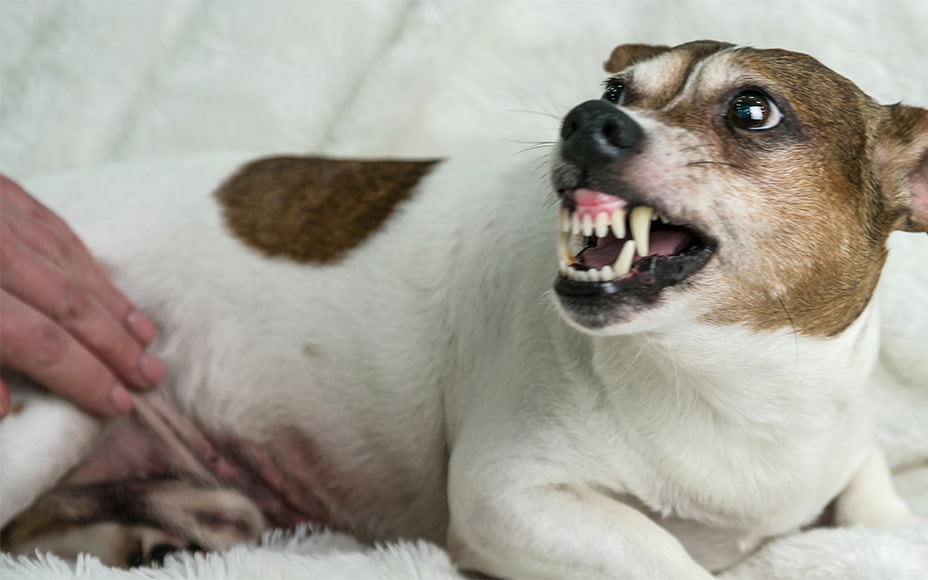
[TRANSLATION ERROR] Vor allem die Grenzen kleinerer Hunde werden häufig nicht respektiert. Knurren und Bellen wird meist als niedliches Verhalten abgetan, können aber auch mit einem schmerzhaften Biss enden.
An example: The dog's goal = keep humans at a distance
A dog that you adopted →second-hand may react aggressively towards other people due to numerous bad experiences and bite. Perhaps in the past, his calming signals were ignored, and he learned that he can only achieve success by biting and keeping people at a distance.
A dog that comes to you as a puppy and realizes from a young age that his individual tolerance is respected and that even the smallest calming signals are taken into account has learned that he achieves success with this behavior (the person retreats) and therefore will not bite directly.
Can aggressive behavior in dogs be corrected?
A correction in dog training can look very different. Even a "Nooo" or a short "Hey!" is a verbal correction. Under no circumstances should you correct your dog's aggressive behavior on your own. This can only worsen the situation. Actions like pressing the dog to the ground, holding the snout, or simply pulling hard on the leash are not suitable tools to help the dog sustainably.
A correction can help your dog understand that he has just made a mistake and that something is not desired. At the same time, you must also show him what behavior is desired instead and promote or reinforce this. Furthermore, it is important to work on the cause of aggression and, ideally, help your dog learn alternative behaviors and navigate life more confidently and relaxed. A correction should never be about simply suppressing aggressive behavior and "keeping the dog down."
Again, a trainer should help you with this. Make sure to find a professional you feel comfortable with, enjoy working with, and whose training methods you support.
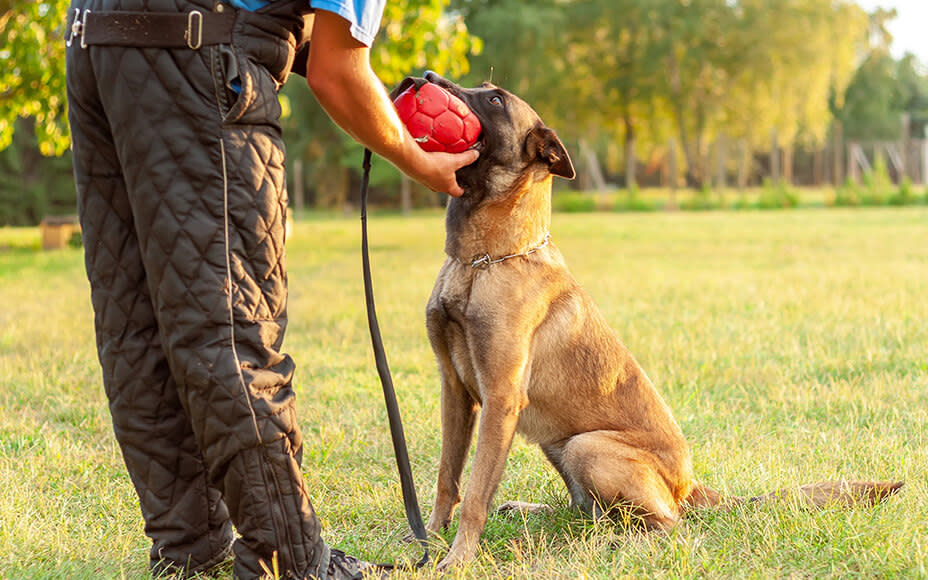
[TRANSLATION ERROR] Wenn du dich mit der Rasse deines Hundes auseinandersetzt und weißt, wie du mit ihr arbeiten kannst, werdet ihr ein starkes Team!
Is there a dog aggression training?
As you can see, the topic of aggressive behavior in dogs is quite extensive and profound. A simple correction usually does not suffice. To truly change your four-legged friend's behavior sustainably and become a team together, →working with experienced dog trainers is almost indispensable.
Since dogs cannot verbally express what bothers them, just as we cannot explain to them in words that they should simply walk past other dogs calmly, a special dog aggression training can be helpful. In most cases, the key to changing a dog's behavior lies with the owners. This means that with the right trainer by your side, you can learn a lot about yourself and your dog, gain more insight into the body language of dogs, and provide your dog with the security and guidance he needs.