
Which tick remedy is suitable for cats?
So much in advance: If your cat is a free-roaming one, an effective tick remedy is not a bad idea. This way, you not only protect your four-legged friend against ticks, →fleas or other parasites, but also yourself. Because it is not uncommon for a cat that roams through bushes and tall grasses to also be a taxi for crawling creatures and brings the little ectoparasites, such as ticks, fleas, lice, and mites into the house.
The following tick remedies have proven effective for cats over time:
Spot-on preparations
These are tick remedies that are applied monthly to the back of your cat's neck. The spot-on remedy spreads through the sebaceous glands of the skin throughout the cat's fur and also enters the bloodstream. They often prevent infestations not only by ticks, fleas, and mites, but also by worms. In this case, only one treatment with a single preparation would be necessary.

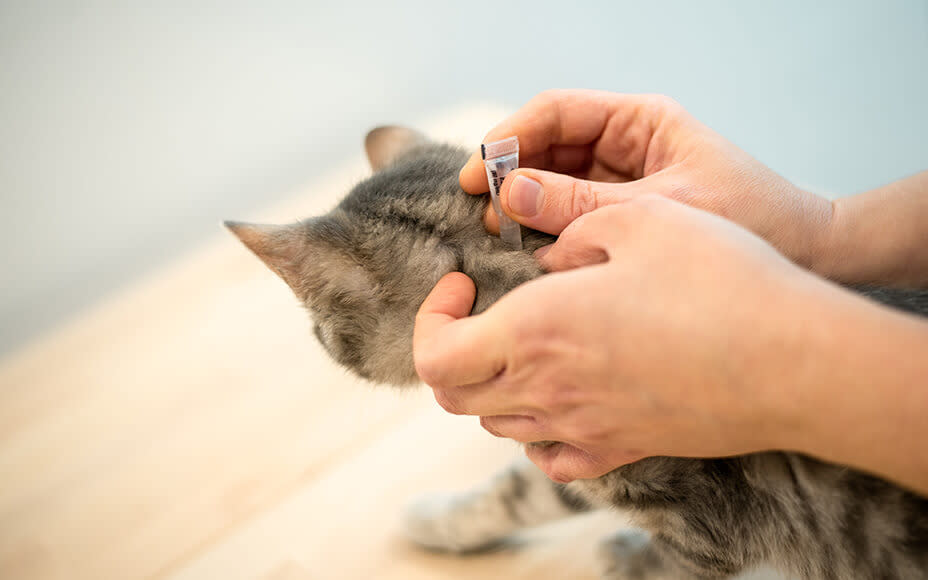
[TRANSLATION ERROR] Spot-on-Präparate kannst du deiner Katze selbst verabreichen. Sie werden meist im Nacken aufgetragen.
Chewable tablets or tick tablets for cats
Tick protection in the form of chewable tablets is very common for dogs. However, they are used less frequently for cats. The reason for this is that the tablets usually only target one group of parasites, either as pure deworming or only against ectoparasites, e.g., against ticks and fleas. Thus, to protect against both important groups of parasites, two treatments with two different preparations would be necessary.
Our tasty snacks are optimal for hiding tick tablets. How about a delicious →cream snack? A bit of cream on your finger, pop the tablet in, and the tablet is elegantly delivered to your cat.
Richtig belohnen dank schmackhafter Snacks


Sprays against ticks
If you are looking for a simple remedy exclusively against ectoparasites, a tick spray can be helpful. It is simply sprayed externally onto the skin or fur of your cat and works immediately. There are even products that are safe for kittens and can therefore be administered to pregnant or nursing mothers.
Tick collars for cats
There are collars that are infused with antiparasitic agents. These only prevent ectoparasites, such as ticks, fleas, and the like. Additionally, your cat must wear the collar continuously for the active ingredients to remain on the skin and thus ensure that the protection is truly continuous.
In general, you should ensure that collars for cats do not fit too tightly. If your cat is often outdoors, there is also always a certain risk that it may get caught on something with the collar and/or lose it.
Natural home remedies against ticks
In addition to chemical agents against ectoparasites, some natural remedies are said to have anti-tick effects. These include, among others, coconut oil, brewer's yeast, various →essential oils as well as amber necklaces or ceramic collars.
However, the effectiveness of home remedies against ticks and worms is often not proven. Additionally, you should check whether your cat tolerates the active ingredients well or has an allergic reaction. Proper dosage and application are also very important and should be discussed with your veterinarian if necessary. Some essential oils, such as tea tree oil, can lead to →poisoning if misused.

[TRANSLATION ERROR] Vor allem Freigänger-Katzen holen sich beim Herumstreifen in der Natur öfter mal eine Zecke und tragen diese mit ins Haus.
Can ticks be dangerous for cats?
Are you wondering whether a tick remedy is even necessary for your cat? As small as ticks, fleas, and the like are, they should not be taken lightly. They transmit a variety of diseases that are not only dangerous for your cat but can also be transmitted to you. If the parasites crawl from your cat to you, the risk of infection for you also increases.
The diseases dangerous to humans and animals that are often transmitted by ectoparasites include:
- Anaplasma infections
- Lyme borreliosis
- TBE (tick-borne encephalitis)
- Babesiosis
- Ehrlichiosis
Therefore, the rule is: better safe than sorry! Consult your veterinarian about effective tick protection products. For some parasites, such as →Giardia, prevention is difficult, and only good hygiene, where all sleeping places and bowls of your furry friend are thoroughly cleaned with hot water, can reduce the risk of infection.