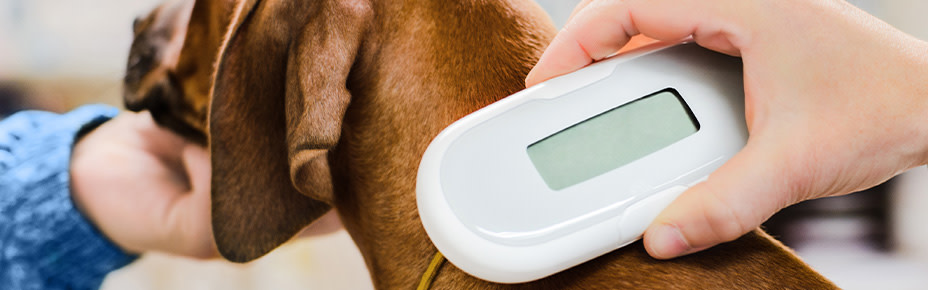
Microchip for dogs – what is it?
A microchip (also: dog chip) for dogs is a small transponder with the official name "RFID microchip." The size is roughly that of a long-grain rice, although there are even smaller chip sizes for smaller dog breeds. Each chip is encoded with a unique 15-digit number, which can only be scanned with a special reader, allowing the dog to be assigned to its owner anywhere in the world.
The following information is read from the ID chip:
Country of origin of the dog
Microchip number/personalized identification number of the dog (unique worldwide)
Manufacturer of the microchip
Why should I have my dog microchipped?
The microchip number is listed in your dog's passport. If a found animal is microchipped, this is always an indication that the four-legged friend belongs to someone and (at first) will not be rehomed.
With the microchip number, you can also, if necessary, prove that the animal belongs to you. So if your dog decides to explore the neighboring towns on its own and is picked up somewhere and brought to the animal shelter, you need to be able to prove that this dog really belongs to you. For this, you can have the microchip number matched with the number listed in your dog's pet passport, compared at the shelter, and then you can take your four-legged friend home with you again.


If your dog ever runs away and is brought to an animal shelter by its finders, it can be assigned to its home there using the microchip.
Is the chip harmful to the dog?
No, the microchip is made of an anti-allergenic material, which is tissue-friendly and does not harm your pet. The chip is inserted in such a way that it fuses with the surrounding body tissue and therefore cannot penetrate deeper skin layers or simply migrate.
But what about radiation? The transponder is inactive, meaning: It does not emit any information or radiation. Only when a special reader is held close to the chip can it be activated and the code read. This type of microchip cannot be located via GPS or satellites and serves solely to identify your pet.
How does microchipping work for dogs?
Microchips are only implanted by veterinarians. Often, dogs are already microchipped as puppies. For homeless dogs found on the street, the chip can also be inserted later without any problems.
The small microchip is implanted without anesthesia using a syringe-like device with a thick hollow needle under the skin of your pet. For dogs, the transponder is globally standardized to be inserted on the left side of the neck. This only takes a few seconds and just pricks your dog very briefly, comparable to a vaccination, but otherwise causes no pain. The chip does not bother your four-legged friend. He cannot feel it and it won't break even during a good rough-and-tumble with his best dog buddy.
To get your dog to set all four paws in a veterinary practice takes a bit of persuasion too. Luckily, most furry friends go crazy for our tasty snacks. Armed with a bag full of delicious beef softies or chicken bites, every visit to the vet will now be right up your dog's alley.
Delicious Rewards for Brave Dogs
Don't forget to register the chip
Once the chip is implanted, it can be read immediately. However, this is useless if your dog is not registered somewhere. So that the chip or chip number can be linked to you when your dog is found, you need to register the microchip number (also called transponder number) with a specialized organization. Veterinarians do not handle registration!
Well-known organizations where you can register your dog include FINDEFIX (free), Tasso e.V. (free), and IFTA (fee-based). To register, you usually need to provide the following information:
Transponder/chip number (can be found in your dog's pet passport)
Information about the dog: species/breed, call name, gender, date of birth, coat color
Name, address, current phone number, and, if applicable, email address of the dog owner(s)
If applicable, a second contact address or phone number

A quick prick and it's done – chipping is comparable to a vaccination and doesn't hurt most dogs at all. But don't forget to register afterwards!
These are the costs you can expect for microchipping
First, you pay the price for the microchip itself. This varies depending on the manufacturer, chip size, and technical quality. Typically, microchips for dogs cost between 30-60 euros. The smaller and more innovative the model, the more expensive it is. For the insertion of the chip you will also pay, according to the veterinary fee schedule (GOT), 19.23 euros. For reading a chip in a dog, you will be charged between 3 and 10 euros.
Is it mandatory to have your dog microchipped?
A general legal obligation for microchipping dogs currently exists in Germany only if your dog belongs to a certain breed that is considered a "listed dog". Which dogs are classified as listed dogs is determined individually by each federal state. In addition, there are different regulations depending on the federal state, regarding if and when a dog must be microchipped. For information, contact your local city or municipal administration.
Microchipping is also mandatory if you want to take your dog on a vacation trip to another European country or overseas. In this case, it is legally required that your dog is microchipped upon entry and that the chip number is entered in the EU pet passport.
Puppies from breeders are usually already microchipped. The reason is that microchipping puppies is a standard breeding requirement of common breeder associations.