
BARF - biologically appropriate raw feeding
BARF stands for Biological Appropriate Raw Feeding, or in German biologisch artgerechte Rohfütterung.
The idea behind BARF is the return to original form of nutrition, because our dogs are originally descended from wild animals. In the wild, wolves hunt other animals and eat their meat and organs. BARF builds on this. Of course, this diet has been adapted to our modern household dogs, and the return to natural feeding doesn't mean: "Here, catch your rabbit!"
But raw meat, isn't that totally complicated and gross? Yes and no! Of course, more work is involved than just opening a can of wet food, but once you've gotten into the concept of BARFing, enthusiasts never want to go back. We'll explain how you can easily get started with BARFing.
How do you BARF correctly?
BARFing is all about serving your dog each food component as fresh and high-quality as possible in their bowl. The exact dosage of BARF ingredients always depends on the size, age, and activity level of your dog. That's why it's nearly impossible to recommend a universal feeding amount, since it must be specifically tailored to your dog's needs. Obviously, a laid-back Maltese will likely need a different composition than an active German Shepherd. And a →senior dog with a gray muzzle again has different needs than when →BARFing a young puppy.

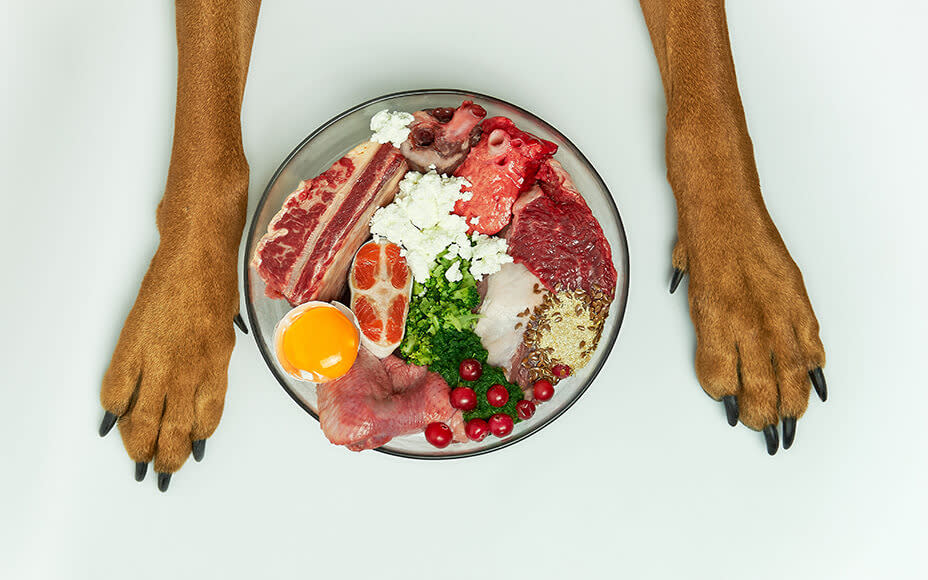
Lots of fresh ingredients, tailored to your dog's needs – it doesn't get any fresher than raw feeding.
A BARF meal usually consists of:
approx. 70% meat (made up of 50% muscle meat, 20% tripe, 15% organs, and 15% raw bones)
approx. 20% vegetables and fruit, with the vegetable portion being much higher
approx. 10% healthy fats or unsaturated fatty acids (omega-3 and omega-6 fatty acids)
Note that there are numerous approaches to BARF feeding and not only the ingredients, but also the composition of the meals can vary greatly.
You'd like to try BARFing, but weighing and assembling everything is too complicated and time-consuming? No problem! Try our "BARF-Complete": fresh meat, vitamin-rich fruits and vegetables, plus valuable minerals and oils already weighed and portioned - for a simple start to BARFing and the full freshness experience in the bowl!

For beginners & time-savers! Our complete menus are your best choice. Wholesome & ready in the bowl!
BARF is not just feeding meat!
The high meat content in your dog's BARF menu already covers a lot of the daily required nutrients. Meat provides your four-legged friend with valuable proteins and fats, which serve as sources of energy. Vitamins are supplied, among other things, from organs as well as vegetables and fruit. Bones provide important minerals, which, if needed, can also be supplied through a mineral supplement. However, the main component in the bowl is muscle meat.
Contrary to what many believe, BARFing is not just feeding meat. Because that would be anything but healthy and species-appropriate. Our dogs also need vegetables and fruit, which provide important fiber, vitamins, and minerals. An omega-3 oil or fresh fish such as →salmon finally provide healthy unsaturated fatty acids. Depending on whether you want to feed your dog components with organs and bones or not, you can also replace these with special mineral mixes.

Regardless of the type of feeding, your dog's meals should follow the structure of the nutritional pyramid for dogs.
The components of BARFing
To understand the roles of the individual BARF components and why they are so important, let's take a closer look at the bowl:
Muscle meat
Meat contains many essential nutrients such as →iron, zinc, and sodium, and essential amino acids, but above all protein, which is important for the animal's growth and muscles. Muscle meat also includes the heart, an important source of taurine. Muscle meat is also quite low in fat and is suitable for both healthy animals and those prone to →overweight.
This meat is also easily digestible for your dog. In our fresh menus, you won't find ground meat, but rather small cut pieces - large enough for big dogs to chew, but also easily eaten by small breeds.
Fruit & vegetables
The prey hunted by wolves, such as game and rodents, are usually vegetarian. That's why wild animals also take in many nutrients from plant sources via the stomach contents of their prey . It's also a fact that wolves like to eat some berries and other greens, which is why you'll also find a vegetable portion in the →fresh menus for dogs.
The vegetables we use for dogs are gently cooked. The cooking process breaks down the cell walls, making all nutrients easily absorbed and the vegetables very easily digested.

Which vegetables can dogs eat? Take a look at our overview!
Did you know that dogs can also be fed a vegetarian or even vegan diet? Read more about this in our →article on plant-based nutrition for dogs.
Important supplements
The original idea of BARFing involves feeding a whole prey animal over a longer period. That means also organs such as green tripe, rumen, but also blood and bones. Only this way are all essential nutrients provided to meet needs.
As mentioned above: Creating a BARF diet plan is very time-consuming and requires a lot of research, otherwise you risk your beloved four-legged friend suffering from improper nutrition in the long run deficiencies.
So if you want to start raw feeding but want to avoid organs, which also carry a higher hygiene risk than pure muscle meat, our fresh menus are the ideal option.
With the 1-2-3-BARF concept, you can turn our Pets Deli fresh menus into a complete food by adding the mineral mix and a bit of oil, covering all the important nutrient components of a classic BARF meal.
Oils
→Oils for dogs like our omega-3 oil, salmon or linseed oil provide important fatty acids, which on the one hand promote digestion and on the other hand contribute to a healthy coat and skin. Alternatively, you can of course also feed fresh fish like salmon or →sprats. Here too, the dosage depends on the size and weight of your furry friend.
Mineral mix
Our mineral mixes are made from natural ingredients such as eggshell powder, green-lipped mussel powder, and spirulina, and cover all nutrients found in organs, bones, and blood—but without the toxins found in, for example, filter organs. The dosage of the mineral mix depends on your animal's size and weight and can be found on the back of our packaging. There is also a distinction between a →mineral mix for adult dogs (Adult) and a →mineral mix for puppies and young dogs.

Supplemented with our mineral mix and a high-quality oil, our BARF menus make it easy for you to get started with BARF.
How much work is BARFing?
Let's be honest with you: BARF means work. Because unlike ready-made complete foods like wet or dry food, you have to assemble the individual food components yourself to suit your dog's needs. On top of that, you must also maintain the highest hygiene standards at all times. After all, you are handling raw meat and organs, where absolute cleanliness must be ensured.
BARFing involves, among other things:
Preparation and research on nutrient and calorie requirements
Creating a diet plan (yourself or by a professional)
Composition of the meals
Sourcing the different ingredients (meat, organs, bones, fruit and vegetables) including space for refrigeration
Preparation
It is also very important that you don't just throw things together at random and mix up meat, fruit, and vegetables. Everything must be precisely tailored to your dog's needs, because if you BARF incorrectly, you risk causing your furry friend deficiencies or undernourishment in the long term.
You see: All these aspects make BARF a comparatively demanding and time-consuming feeding method. Ideally, you should get advice from trained nutrition or BARF consultants beforehand and have an individual diet plan created for your dog. Alternatively, you can try our practical 1-2-3-BARF concept:
With our Pets Deli fresh menus and the 1-2-3-BARF concept, we combine fresh BARFing with a simple and straightforward feeding routine:
DEFROST: Take out of the package and let thaw in the fridge for about 12 hours before feeding.
ENRICH: With →our mineral mix and →our cold-pressed oils, the fresh menu becomes a balanced and complete meal for your furry friend.
FEED: Now put it in the bowl and let your dog enjoy!
You'll love to try BARF!
Two BARF methods compared


Is BARF better than dry or wet food?
Regardless of the →right feeding method for your dog one thing is clear: It's the ingredients that make the difference. Every food is only as species-appropriate as its ingredients (and their quality). Whether you choose →BARFing, wet food, or dry food—what matters is that the chosen food contains a high meat content or another protein source. Muscle meat is particularly high-quality and healthy for your dog, while →vegetables provide important vitamins and minerals.
Meat of lower quality is often indicated by vague labeling such as "meat and animal by-products"—which can include feathers, claws, hooves, horns, and wool . A portion of fresh fruit gives an extra boost of vitamins and ensures a fresh, fruity taste. →Selected herbs and →oils refine the food and round it off with important fatty acids.