
How to Feed Your Dog Properly
Your furry friend is your treasure on four legs, always by your side and practically putting their life in your hands. After all, you are their human and choose what food is right for them. It's understandable that you come to the question of what proper nutrition for dogs actually means and what to consider. →Healthy Pet Food sets the course for a long life with your furry friend. We explain how that looks here.
Proper Food: The Healthy Components
A look at the labels of conventional dog food shows that different standards apply to the nutrition of four-legged friends than to us. It's not uncommon to find animal by-products, sugar, grains, and other questionable additives. Everyone knows that dogs are descended from wolves, but what this specifically means for the →composition of the food is revealed by a look inside the stomach of the prey.
That's right, because in addition to the prey itself - like a rabbit, for example - wolves eat the prey along with its stomach contents, which includes vegetables, fruits, and herbs. So, anyone who thinks: My dog gets nothing but meat in the bowl should take a look at the natural eating behavior of (wild) dogs. The main component is therefore usually meat, with additional parts from vegetables, fruits, and herbs. Why, according to scientific studies, meat is no longer considered the only main ingredient of choice will be explained shortly. It should be noted that dogs have adapted in terms of nutrition and can now process starch differently than wolves.


Ein artgerechtes Futter sollte aus einer gut verwertbaren Eiweißquelle bestehen sowie frischem Gemüse und Obst - verfeinernde Kräuter und Öle spenden Mineralstoffe und wichtige Fettsäuren.
At Pets Deli, we strictly adhere to the findings on healthy nutrition for dogs. Are you still looking for the right food or want to lay the foundation for a healthy life?
Mach deinem Hund eine Dose Freude auf!


What Should Not Be in Healthy Dog Food?
You now know what should be in dog food for proper nutrition. Another look inside the prey's stomach would show us that sugar and artificial colorings, flavorings, and preservatives are nowhere to be found. However, the reality of some dog food varieties shows the opposite, and it's not uncommon to find a high proportion of grains alongside sugar. Whether →grains in their form are harmful to dogs depends on several factors. The fact is, however, that dog food that consists largely of grains is not healthy and extremely hard to digest for dogs, as the gastrointestinal tract is simply not designed to digest grains in such large quantities.
Grain types, according to studies, also form the largest group of allergy-inducing food components, which can manifest as →itching, hair loss, and other symptoms. Additionally, sugar and grains contain a high amount of kilocalories, which can lead to overweight.


[TRANSLATION ERROR] Zucker, Getreide und künstliche Zusätze können nicht nur allergieauslösend sein, sondern sind in der Menge auch wahre Dickmacher für deinen Hund.
All Around Proper: Dry Food, Wet Food, or BARF?
Regardless of the →right feeding method for your dog, it can be said: The content makes the difference. Every food is only as proper as its content. The chosen food should contain a high meat content or another protein source. Muscle meat is particularly high-quality and healthy for your dog, while vegetables like →broccoli, →(sweet) potato, carrots, zucchini, or →pumpkin provide important vitamins and minerals. The declaration "meat and animal by-products" indicates lower quality meat - which can include feathers, claws, hooves, horns, and wool. A portion of fresh fruits like mango, papaya, apple, or raspberry provides an extra boost of vitamins and ensures a fresh, fruity taste. →Selected herbs and oils refine the respective food and round it off with important fatty acids.
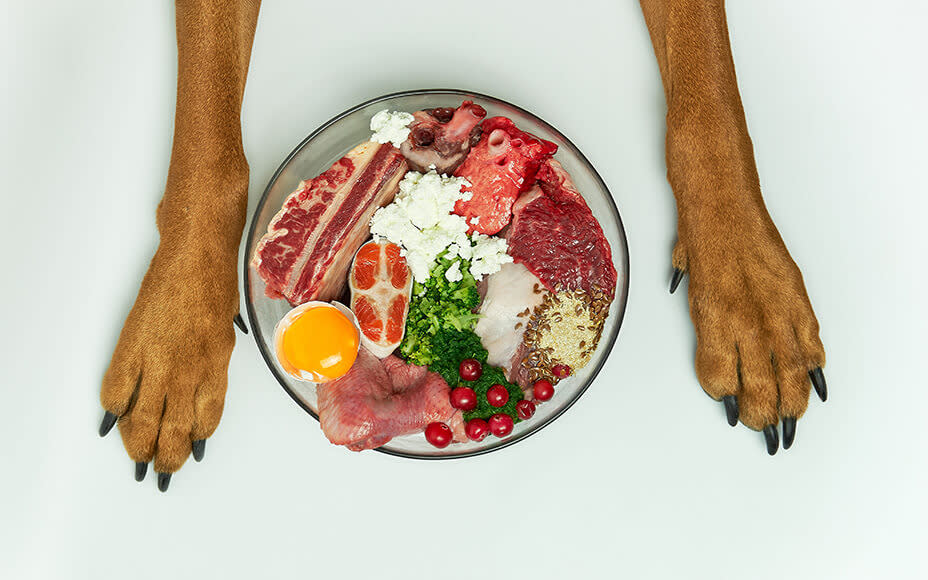
[TRANSLATION ERROR] Unabhängig von der Fütterungsart macht die Qualität des Futters den Unterschied.
You can find these compositions in both wet and dry food as well as in BARF. Do you want to cook for yourself? →BARF does not necessarily mean homemade, as there are usually pre-portioned menus that are either enriched with all necessary minerals or can be easily dosed. When cooking your own menus, a detailed consultation with your veterinarian is essential, as over- or under-dosing is not uncommon and can do more harm than good to your four-legged friend.
All Veggie, All Proper?
With the trend towards vegetarian and vegan diets, the question arises whether your →dog can be fed vegetarian or vegan. The answer is: Maybe. Unlike cats, which need amino acids from meat to survive, dogs can digest and utilize carbohydrates to a greater extent. Generally, if a dog tolerates meat types without issues and has no →food allergies, there is no reason to switch to vegetarian or vegan food.
If an elimination diet shows that no type of meat is tolerated, a switch to vegetarian food can be made, as this can provide your dog with everything they need for a healthy daily life. Proteins are provided by lupins, lentils, peas, and vegetables, while fruits deliver important vitamins. The idea that dogs, as omnivores, are dependent on meat for a healthy life can now be dismissed as one of →many food myths. The quality of the respective protein source and how well your dog can utilize it is what matters.
Did you know that insects are very popular with dogs and are also sustainable? What sounds like a big crunch is actually rich in protein, flavorful, and leaves a →much smaller ecological footprint. Sniff through our Pets Deli GREEN range and let your four-legged friend try it out!


Do you want to easily become a feeding pro? Our →Food Guide for Dogs explains to you comprehensively, yet still easily understandable, what to consider in dog nutrition. Thoroughly researched and developed under the watchful eyes of our veterinarians, the guide is here to assist you with advice and support.